Contract armies?
Russia's well-paid 'mercenaries' and Ukraine's enslaved 'peoples army'. Tunnels, 1789, negotiations, Zaluzhny.

Poker and Chess
As the armies of Epstein martyr the 86-year-old Ali Khamenei, I am reminded of an interesting passage by the veteran CIA operator John Stockwell. He believed that western aggression would harm it in the long-run.
Writing in the early 1980s, Stockwell was concerned with how Washington’s sponsorship of Angolan armed groups allied with apartheid south Africa would damage US interests:
the Soviets’ national sport is chess and their foreign policy reflects an effort at long-range planning of coordinated, integrated moves, although they often play the game badly and are given to serious blunders. The Chinese are notorious for planning their foreign policy carefully, with moves designed to reach fruition even years beyond the lifetimes of present leaders. By contrast, Ambassador Black observed, the United States is a poker player. It looks the world over, picks up whatever cards it is dealt, and plays, raising the stakes as more cards are dealt, until the hand is won or lost. Then, after a drag on the cigarette and another sip of whiskey, it looks around for the next hand to be played.
From a chess player’s point of view the intervention was a blunder. In July 1975, the Soviet-aligned MPLA was clearly winning, already controlling 12 of the 15 provinces, and was thought by several responsible American-officials and senators to be the best-qualified to run Angola; nor was it hostile to the United States. The CIA committed $31 million to opposing the MPLA victory, but six months later the MPLA had nevertheless decisively won, and 15,000 Cuban regular army troops were entrenched in Angola with the full sympathy of much of the Third World, and the support of several influential African chiefs of state who previously had been critical of any extra-continental intervention in African affairs. At the same time the United States was solidly discredited, having been exposed for covert military intervention in African affairs, having allied itself with South Africa, and having lost.
That’s all very well and good, but Stockwell’s analysis was not quite justified by the rest of the 1980s. According to his own book, the CIA’s $40 million in support for anti-communist rebels forced the Soviets to spend $400 million supporting the MPLA. By the end of the 80s, pro-American forces had won out in Moscow. Gorbachev and his sidekicks often cited cases like Angola as examples of how draining an anti-NATO foreign policy was. And within a few years, the Soviet Union itself disintegrated.
My point is that American aggression seems more effective than whatever long-term strategy Moscow or Beijing have. Poker beats chess.
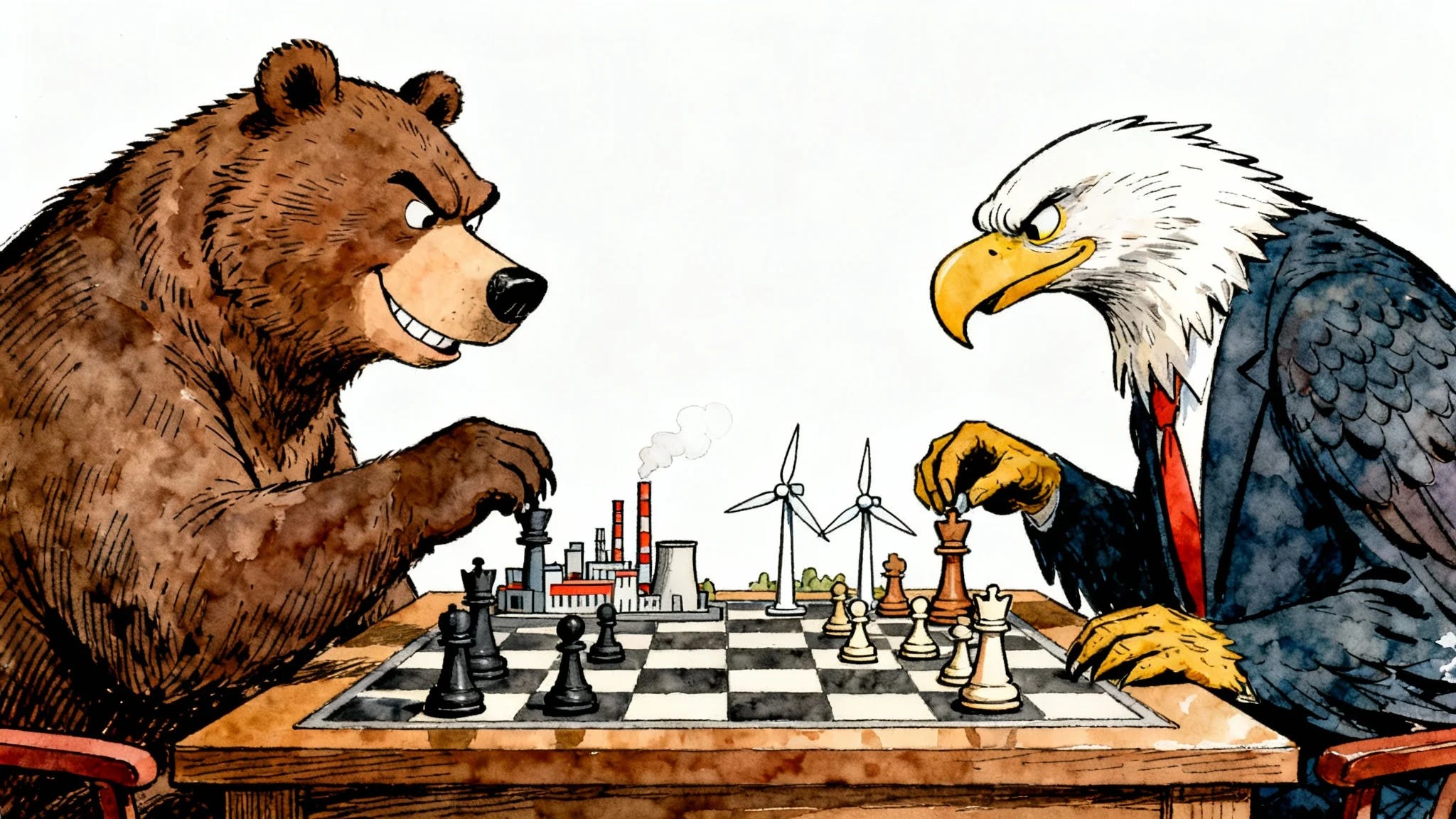
Some people like talking about some sort of masterful strategy being realized to undermine western hegemony. But what good is strategy if your opponent shoots you in the head? As Keynes said, in the long run we are all dead. The Tel Aviv-Washington axis seems fairly adept at destroying the long-term through immediate executions. Whatever discomfort the rest of the global majority/third world might experience seeing this blatant imperialism seems to be irrelevant.
Of course, the fact that China and Russia possess nuclear weapons make a repetition of the Iran scenario there rather unlikely. Instead, NATO confronts them through its proxies.
Besides, Moscow’s main strategy is not to obliterate the west. Instead, the aim is to put up enough of a fight in Ukraine to convince NATO that it must deal with Russia as an equal. Beijing is even less inclined to engage in any actual confrontation with the west.
However, this does not mean that a backroom deal between Moscow and Washington is likely to come about any time soon. NATO is unwilling to entertain any acknowledgement that it is not omnipotent. Nor do Russian officials see much need to backtrack on their demands. Hence, the war will continue.
And despite the undeniable power of poker, there are some processes that continue over a longer time frame. Instead of the sky wars of the middle east, the land war of Eurasia. Armies, masses, mobilization, numbers.
Contracts
Faced with the effectiveness of Russia’s contract recruitment campaign, Zelensky is talking of emulation. Despite martial law and compulsory mobilization of all men aged 25 to 60, Ukraine still lacks sufficient manpower. This is what he said in a February 23 BBC interview:
When we talk about personnel, Europeans can help if – or when – we transition our army from mobilization to contracts
The same thing (Vladimir) Putin is doing: he pays each person money for a contract. We want this as well, but we do not have enough funds. This is where Europeans could help. This program is not yet financed by Europeans.
But it took so much effort for the Europeans to simply gather enough willpower to decide on sending 90 billion euros to Ukraine for 3 more years. Currently, Hungary is still blocking this loan from actually reaching Ukraine. Hence, I find it hard to believe that they will find the wherewithal to send enough money for Zelensky to build a contract army. Russia spends 4 trillion roubles a year on its contract army — more than 40 billion euros.
That’s because Russian soldiers receive around $25,000 USD simply as a one-off payment for signing a military contract. After that, they receive $2,500 to $4,000 USD in monthly payments. A mobilized Ukrainian soldier receives less than $500 USD a month.
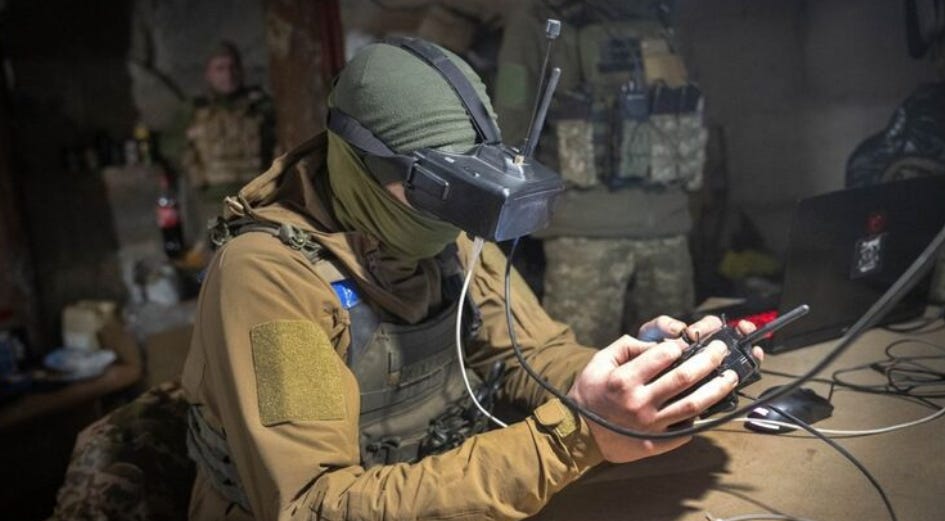
Furthermore, in February the Russian army began conducting a new campaign to recruit drone operators. The Russian armed forces is setting up its own unmanned systems forces. This is a seeming analogue to the Ukrainian Unmanned Systems Forces, set up in 2025 but still a rather chaotic beast with unclear results.
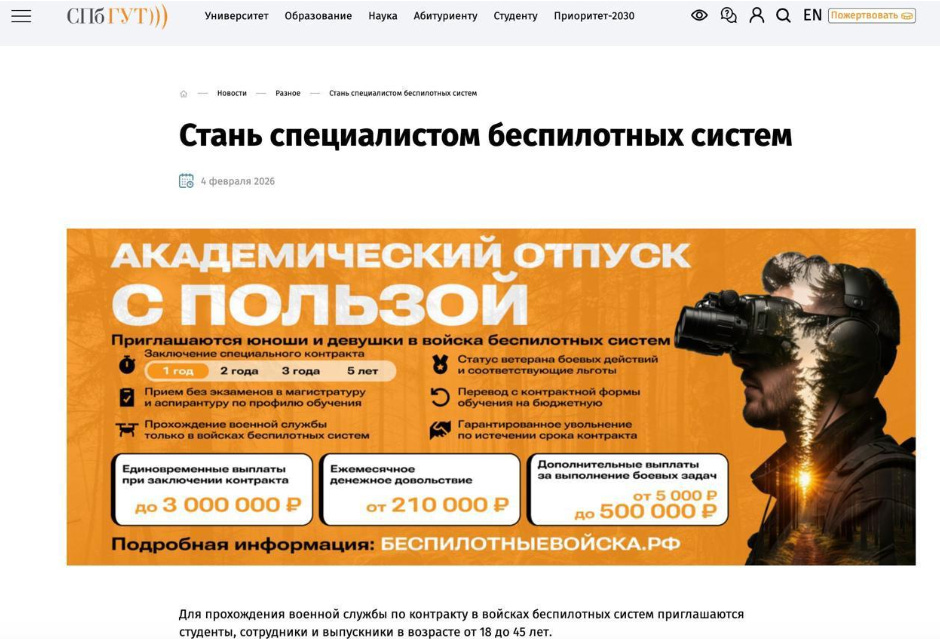
What’s important is that these Russian UAV operators are being offered a salary of 210,000 rubles per month ($2,750) and bonuses of up to 500,000 rubles for completing missions ($6,500), as well as a one-time payment of 3 million rubles ($39,000). Very importantly, the contract is for one year, after which the operator can leave the battlefield.
Here you can see an advertisement at a Russian university for this UAV operator program:
In the Ukrainian army, all soldiers serve indefinitely. The only exception is for the one-year youth contracts for those aged 18-24, introduced in 2025. But even here, one only receives a 12-month deferment from mobilization after finishing the contract. This means one can still be mobilized after a year passes.
It is also often quite difficult for infantrymen in the Russian army to leave. In both the Russian and Ukrainian armies, infantry are relatively scarce resources, and no commander wants to simply let go of his subordinates.
However, things are different for drone operators. The salaries are so high, and there are so many people interested in this relatively safe position. As a result, it is quite feasible to offer one-year contracts. But only if the state actually has the money to back that up.
Forever war
A reliable look at how Ukraine’s western-funded liberal intelligentsia sees the future can be gleaned from the publication Ukrainska Pravda. This publication is owned by Czech financier Tomas Fiala, a major investor in Ukraine’s agricultural and media sector, as well as being a long-time associate of the Soros family.
Ukrainska Pravda’s recent content has been quite sanguine about the certainty of continued war, and continued mobilization. And they’ve been publishing a number of articles that actually glorify the mobilized ‘people’s army’ wielded by Ukraine, as opposed to the dirty ‘mercenaries’ that Russia employs. This moralization has not been met with understanding by Ukrainian soldiers actually serving in the army.
In a March 1 publication, a psychoanalyst interviewed by Ukrainska Pravda informs readers that it is necessary to accept the long-term continuation of the war.
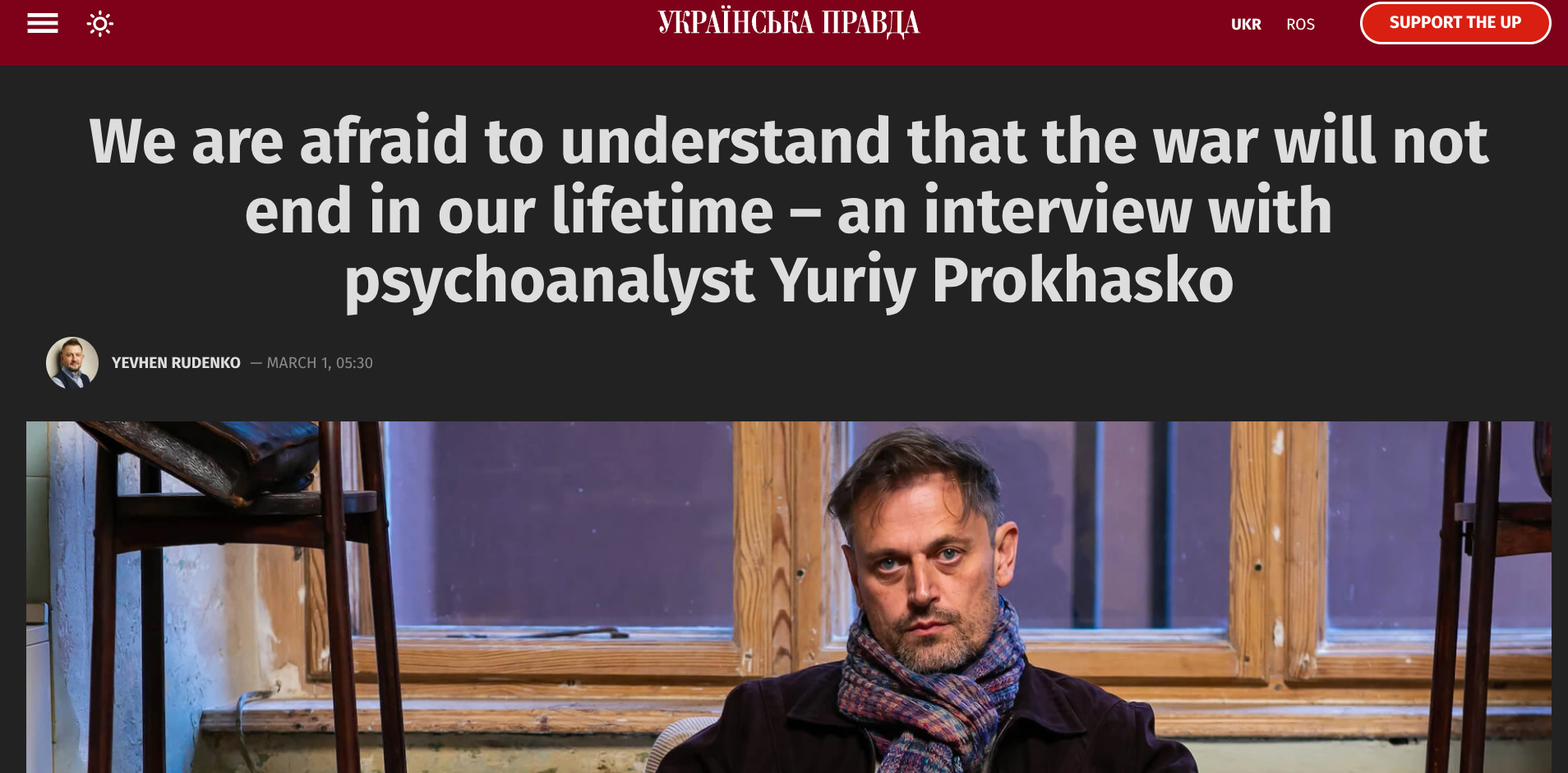
The psychoanalyst is particularly perturbed at the tendency of many Ukrainians to blame their own government for the war;
Yuriy Prokhasko: Recently in Lviv I witnessed a scene after one of the most severe bombings of the Lviv region. I was riding in a tram that suddenly stopped because the power went out. There were ladies on that tram, very well dressed, looking educated and nationally conscious. They started to indignantly shout: "So this is genocide!" And so they turn to me: "This is genocide, isn't it?" I say: "Of course, genocide. Who doesn't see that Russia is committing genocide?" And they say: "No, no! Then our government is committing genocide." That is, this is a reversal, a reversal of the roles of the rapist and the victim.
He explains such a reversal using Freudian theory. Urging against such perversions, along with other ‘conspiracy theories’, the psychoanalyst calls for truly nationally conscious Ukrainians to find happiness in the continuation of war:
we are afraid to understand that in our lifetime we are not destined to see what can be called "peace". That the war will never end in one way or another in our lifetime. But, perhaps, if we understand this, we can somehow learn to live more. That’s exactly how it is – between life and the threat of losing it. And perhaps this will give us some way of living that will allow us to preserve life more.
Note that not everyone was convinced by this psychoanalyst’s opinion on military affairs. The nationalist telegram Tales of the IV Reich wrote this on March 1:
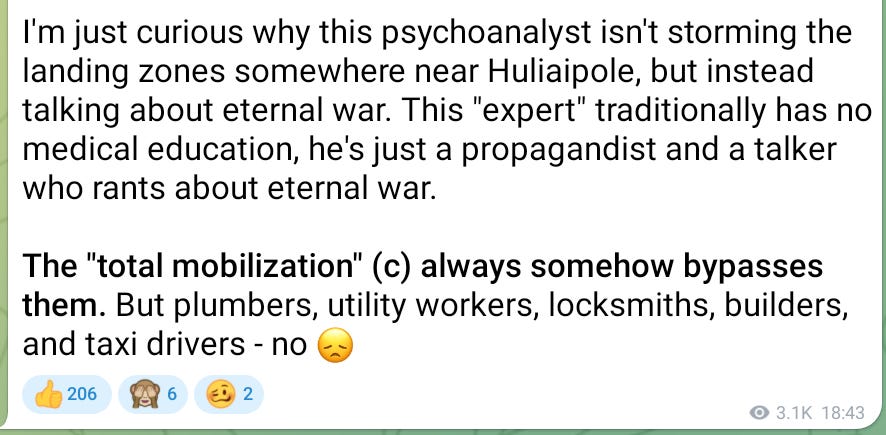
In a follow-up post, Tales argued that the corrupt gang around Zelensky has made an alliance with the sophisticated liberals that write for Ukrainska Pravda. The former want endless war in order to scale up their embezzlement schemes, the latter want endless war to satisfy their western sponsors. As shorthand for Zelensky’s coterie, Tales uses the term ‘Myndiches’ — referring to Timur Myndich, the old Zelensky associate that comfortably left to Israel following revelations of his large-scale embezzlement on state energy infrastructure in wartime.
The “Mindichis” are trying, through their loudmouths, to imprint in the minds of Ukrainians a syndrome of jihadism and eternal war. To achieve this, privileged people in camouflage never leave YouTube channels, various psychoanalysts, tarot readers, “experts” in anilingus, fortune-teller Tamara, and other categories of citizens go on air — their task is to legitimize and search for meaning in the fighting, and to normalize in Ukrainians’ consciousness the chaos, mass deaths, and the search for meaning in the loss of territories and constant destruction.
The only goal is to preserve the war status quo and the power of the pathetic organized criminal group “Mindichi.”
On February 25, the well-known military correspondent for the television channel TSN published her own column for Ukrainska Pravda. The title is quite suggestive:
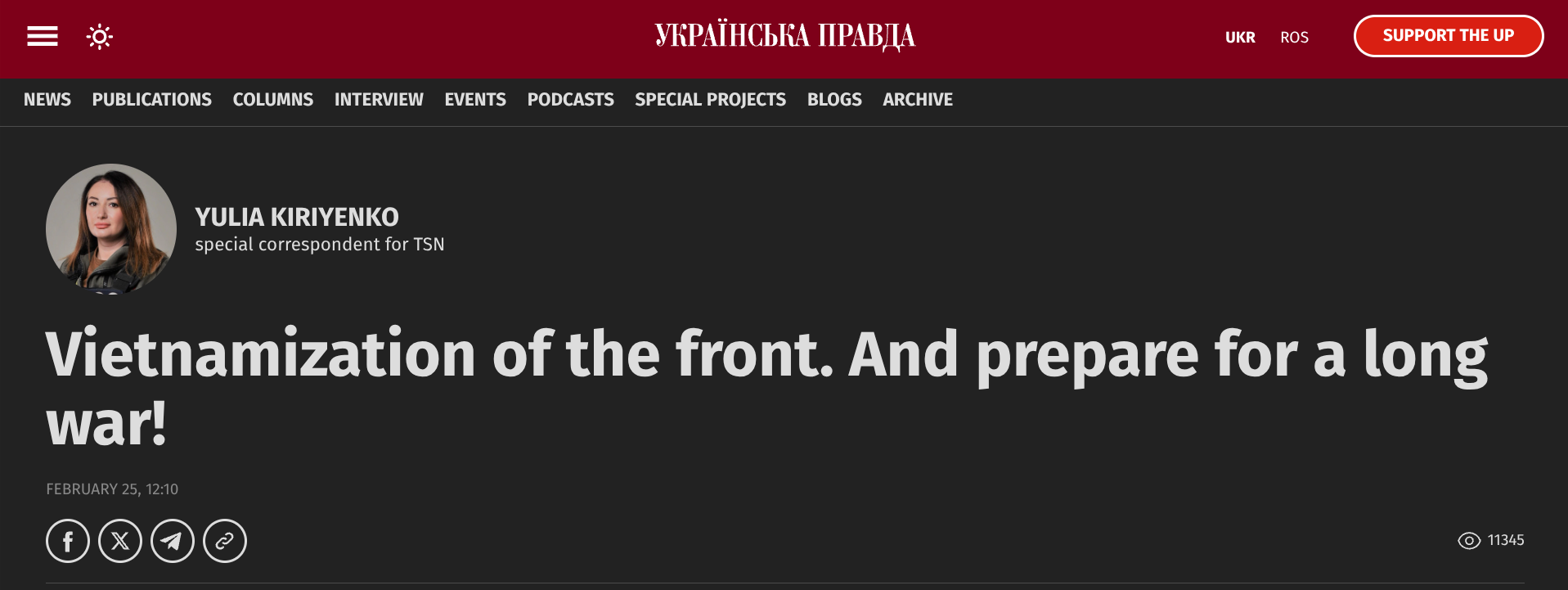
This was actually a rather interesting article.
