It’s been a while since I’ve done a roundup of drone developments. My last such post was in October. Today we’ll return to this hallowed format.
After all, as Ukrainian drone expert Sergei Bezkrestnov said in a December 17 interview, this realm of military technology has global implications:
When I attend military exhibitions in Europe and around the world, I see these tanks — Leopards and other developments — costing tens of millions of euros. And you realize that when a tank worth 12 million can be destroyed by five FPV drones costing $500 each, it becomes unclear what’s going on. Either people around the world still don’t fully understand the reality of how war has changed, or they believe that tanks simply must remain on the battlefield. But unfortunately, in the current war, if you ask our guys when they last saw a tank, the answer is: very rarely.
Humans and drones
Before we get to the hardware, the people running them.
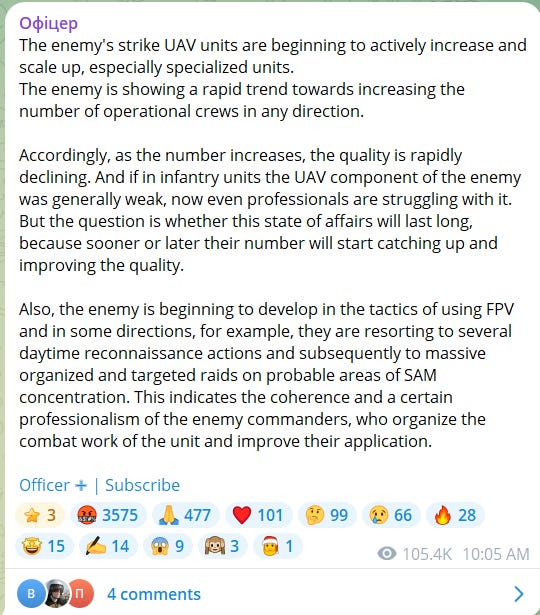
Russia’s Rubicon drone team was one of the most important characters of 2025, and it is going nowhere. In fact, it is sharing its experience with other units of the Russian army. Here’s what Ukrainian military blogger Officer reported on Russian drone training on January 7. By the way, ‘SAM’ is an incorrect translation of a Ukrainian abbreviation referring to Ukrainian troops.
There are a range of forces pushing Russian technological development. Bezkrestnov names in particular the Rubicon and the factories producing Shahed/Geran drones in Yelabuga and Izhevsk:
Thanks to radar systems and Rubicon technologies, they started shooting down our reconnaissance UAVs and bombers — the “Babayaga.” They couldn’t detect them before; now they can. These bombers are priority targets. They even strike 20–30 km deep thanks to relay transmitters. This is all Rubicon technology.
How effective have they been over the last three months? Has it increased? We’ve learned to counter them. I don’t see radical breakthroughs on their side — mostly scaling, more stations, more crews. The only truly new thing is Starlink — but that’s Yelabuga and Izhevsk teams working on Shaheds and Gerberas, not Rubicon.
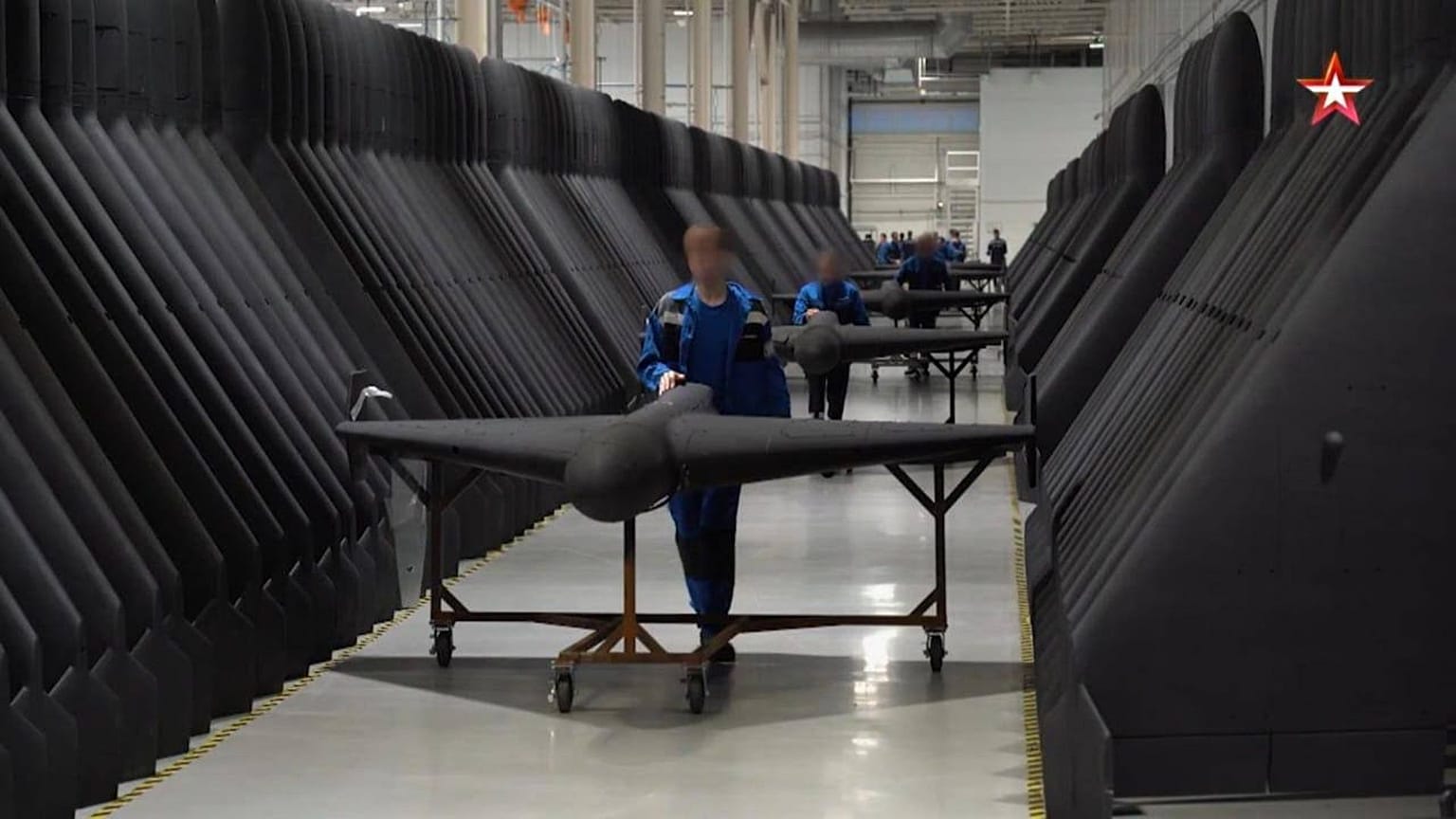
A 2025 photo from the Yelabuga drone factory. Pictured are Geran drones
Rubicon also started working on unmanned boats — something new for them. It’s not just a combat unit; it’s a research center, pilot school, and development hub. Pilots pass experience back to engineers, who refine systems. So we can expect new surprises.
Technology always reflects social relations. Soviet Ukraine had an enormous industrial sector, and hence every other person was an engineer. Today, there are no more factories, and intelligent young people instead become programmers for western companies. But as Bezkrestnov points out, knowing how to code isn’t that useful when it comes to building drones:
We’ve trained a generation of IT specialists, but lost the generation of classical radio engineers, circuit designers, antenna specialists, electronics people. I recently visited a workshop in a brigade—most designers are 50+; there’s almost no youth. Some enthusiasts exist, but real practical experience is rare. Future signalmen in the army lack hands-on skills: soldering, using a tester, building routers, satellite dishes, wiring, generators, replacing counters, installing routers. These are basic technical tasks, yet they don’t have training.
3D printers can’t solve the lack of engineering school. To print something, you need drawings, plans, and experiments. 3D printing is just a tool; someone still has to design, test, and iterate. In military contexts, 3D printing solves a lot—Russian AI drones also partially use 3D printing. Semi-military enterprises don’t shy away from these technologies. On the frontlines, you see workshops full of printers—40–50 printing simultaneously antennas, stabilizers, parts. People manage to design and assemble things even in trenches.
The rest of today’s article will be dedicated to hardware. First, the range of new methods developed by the Russians to increase the range and quality of connection with their drones.
Next, a comparison between the Ukrainian approach of developing a wide range of competing models, as opposed to Russia’s standardization strategy. This leads us onto the latest information about Russia’s mysterious AI-powered drones, thermite-dropping drones, land-based robots, electronic warfare and Chinese radar systems.
Finally, we’ll cover the latest updates to Russia’s Geran/Shahed drone. This includes MANPADs installed on the UAV itself, infrared spotlights to blind interceptor drones, and much more.
Connection
Now, onto the connection between man and drone.
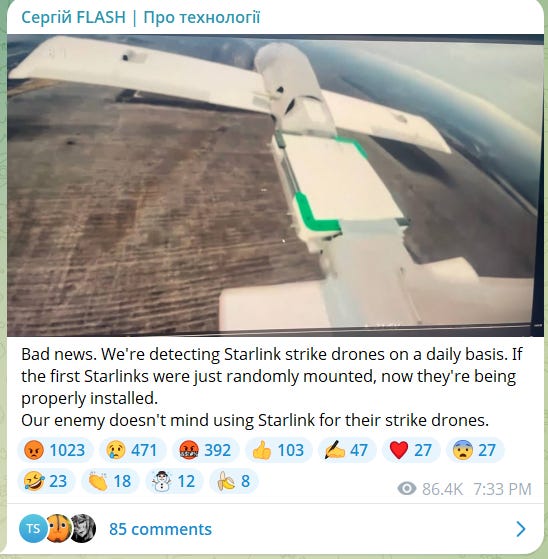
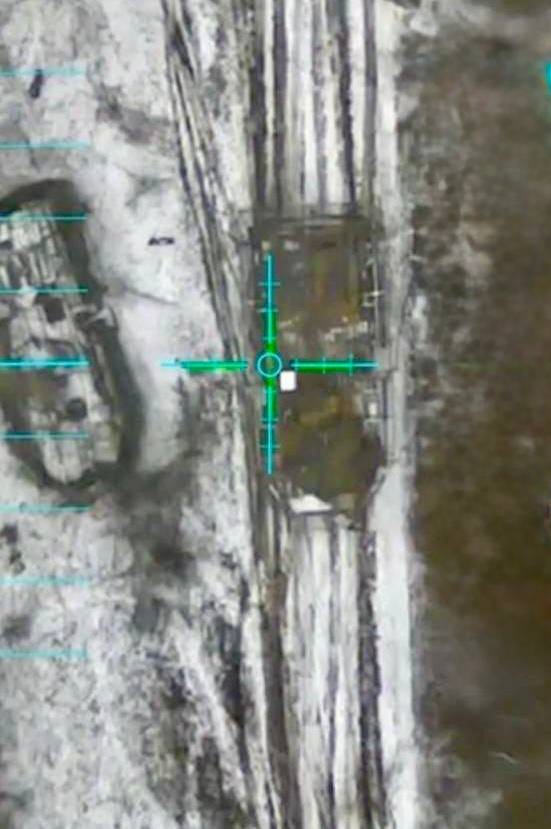
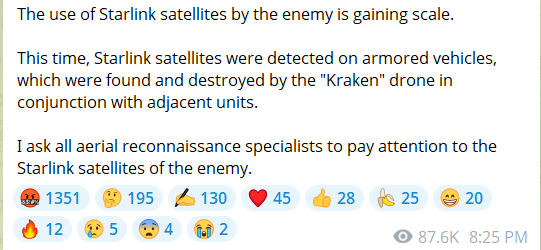
Sergei Bezkrestnov warned on the 14th that Russian drones were being increasingly spotted with Starlink internet providers installed on them. This allows for better controllability by the pilot. The Russian drone visible is a Molniya short-range attack model.
On December 18, Bezkrestnov shared photos of Russian vehicles with starlink satellites strapped on top.
Writing on December 27, Bezkrestnov explained why this use of starlink is so dangerous:
Continue reading this post for free, courtesy of Events in Ukraine.