EU weapons complex rises?
Corruption, record IPOs, data. US-Israeli startups vs Korean-Russian monopolies.

Today we’ll be looking at the fortunes of Fortress Evropa.
There’s no denying that European defense spending is exploding. Take this February 2026 prediction from McKinsey.
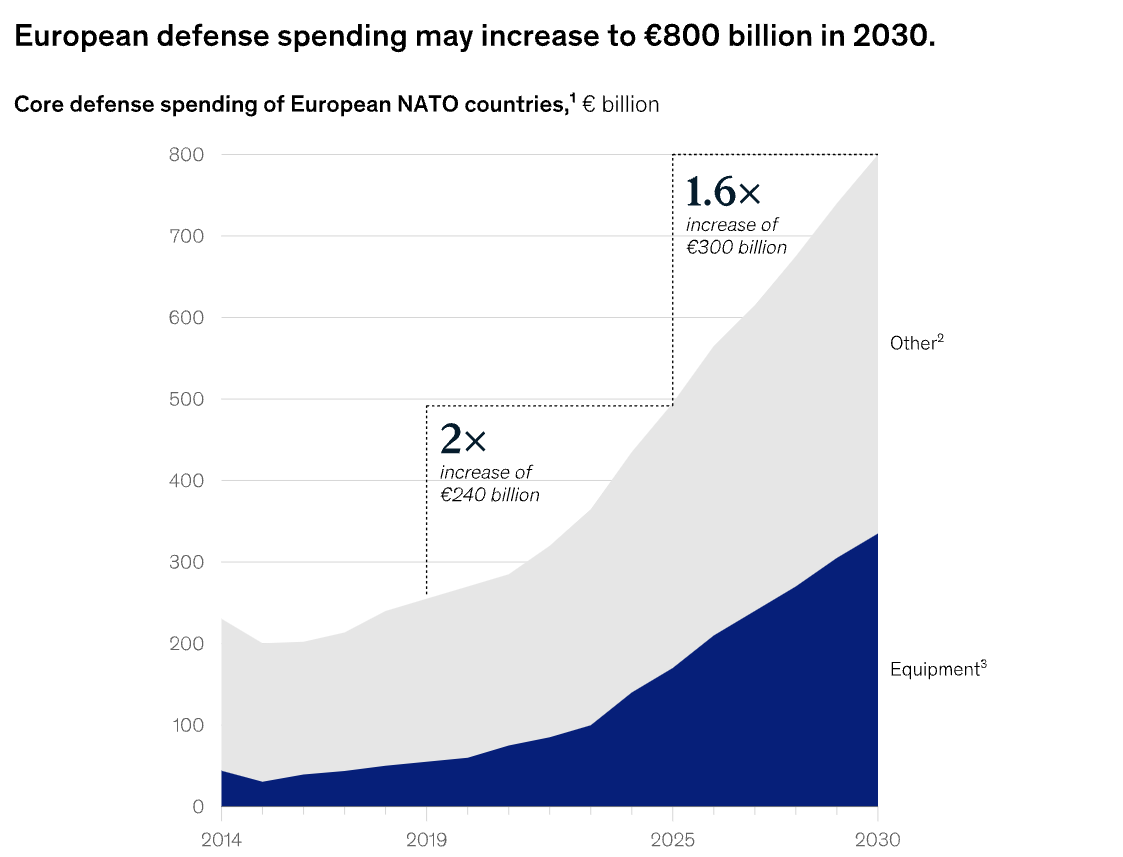
By comparison, the US military budget for 2026 is set to be just over 800 billion euros.
But I can’t shake the suspicion that all the money being pumped into it does not have the intention of actually fighting a land war with Russia.
So what weapons are all these euros paying for? Where are they made, what are they capable of? Is it all a highly civilized boondoggle?
Instead of producing large numbers of cheap drones and artillery, they are focusing on expensive sitting ducks like fighter jets and tanks, as well as other expensive and single-use waste. Because of shipments to Ukraine, European armies actually have fewer units of equipment in 2026 compared to 2021, even if much has been modernized. But in peer warfare, it is quantity that counts.
And instead of creating massive Korean-style chaebol monopolies, the European press is full of calls to follow the ‘US-Israeli example of diverse military startups’.
Even worse, the Europeans seem intent on castrating the military industrialists that do exist with ‘corruption investigations’. As we’ll see at the end of today’s article, the richest man in central and eastern Europe, whose military firm earned the largest IPO in global military history at the start of 2026, is now facing investigation for fraud. If they wanted to catch up with Russia, they should simply throw people out of windows instead of getting stuck in this bureaucratic red tape.
Instead, there are several other interests. One is lining the pockets of European business. Another is lining the pockets of American arms exporters. The Ukrainians are also sticking their nose in. Europe’s main military industrial official is loudly confident that he does not see any issues with the fact that the past year has seen a number of major corruption scandals in Ukraine’s arms sector.
The Europeans are proposing some seemingly reasonable legislation on the localization of military industry (legislation they forbade Ukraine from implementing, incidentally). But American resistance and conflict between French and German firms seem to complicate these plans.
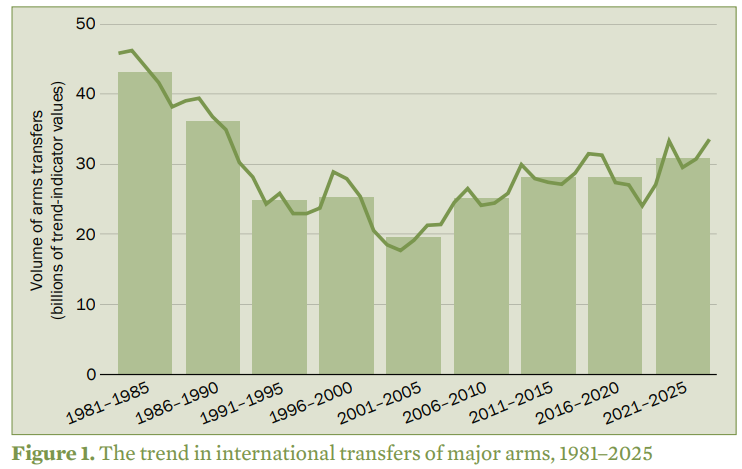
Global trends
The Stockholm International Peace Research Institute (SIPRI) released its annual report on the arms industry on March 9. It showed weapons imports decreasing around the world — except for Europe.
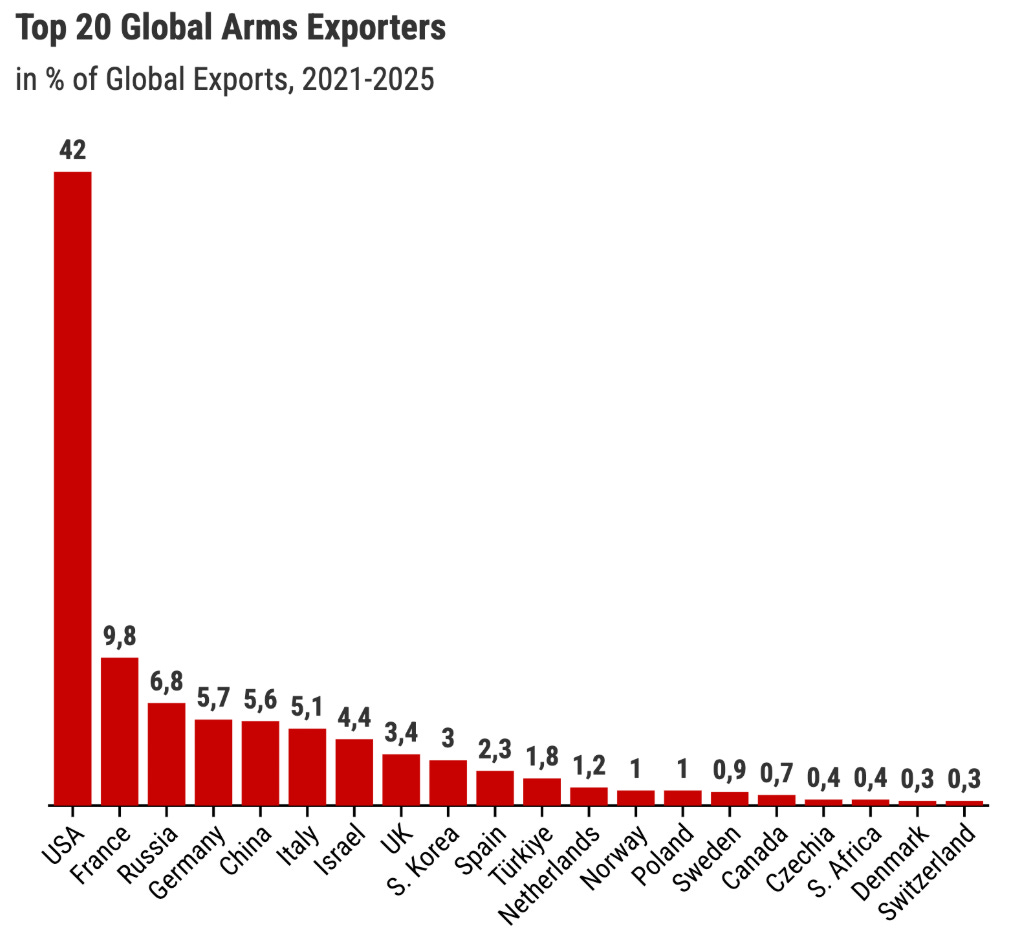
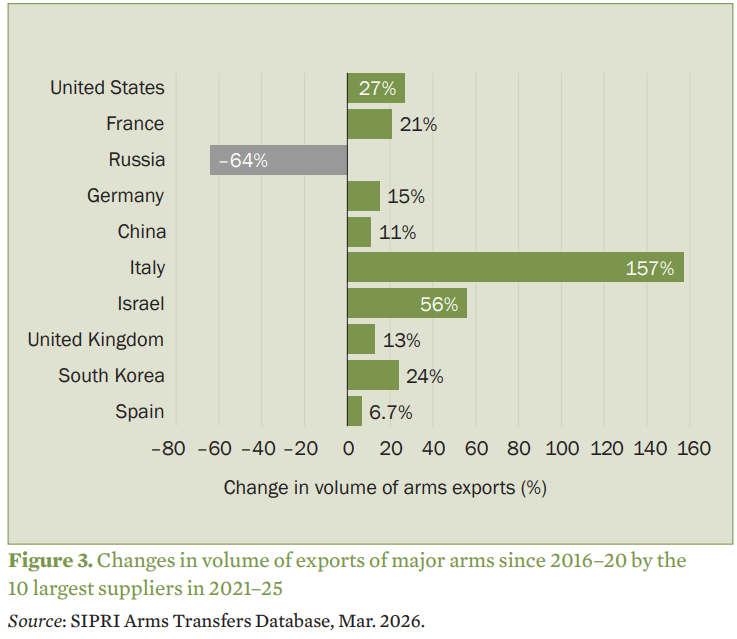
The US has seen its share of the world arms market significantly increase over the past five years. War, as usual, is good for business on the American island. Israeli arms exports have also soared.
First, imports.
European arms imports increased by 210% in the 2021-25 period, as compared to 2016-20. This was very good for the USA, which saw its arms exports increase by 27% overall, and by 217% to Europe. The US accounted for 58% of all weapons imports to European NATO members. This is the first time in 20 years that Europe has been the main destination for American weapons firms.
The war in Ukraine was behind this, with Ukraine responsible for almost 10% of all global weapons imports in 2021-25. This is an increase of over 120 times compared to the 2016-24 period.
The SIPRI found that 43% of the increased European demand for weapons imports was sent to Ukraine. Poland received 17% of all arms imports from European NATO states, a ninefold increase compared to 2016-2020. 47% of Poland’s imports came from South Korea, and 44% from the USA.
41% of Ukraine’s weapons came from the USA, with 14% from Germany and 9% from Poland. Despite increased European arms exports to Ukraine, decreased US aid in 2025 meant that the volume of weapons transfers to Ukraine dropped significantly in 2025. Though SIPRI admits that increased American secrecy in 2025 prevents precise calculations, it estimates that 25% of all US arms shipments to Europe in the 2021-25 period went to Ukraine.
Russia, by contrast, received 0.4% of global weapons imports, mainly from Iran and the DPRK.
Now, onto exports.
Though importing more than ever, EU arms exports also increased, though by much less. Exports rose by 36% in the 2020-25 period. This is almost 10% higher than the equivalent US growth rate, and 25% more than Chinas. Where the US now accounts for 42% of the global arms sector, EU exports take up 28%, almost as much as EU imports (33%).
Russian exports declined by 64% over the 2020-24 period. This was largely due to decreased exports to China, Algeria, and Egypt. China, in particular, has been producing weapons systems domestically it previously produced.
The rest of the world imported fewer weapons. Previously significant weapons importing countries such as China, Australia, India, South Korea, Algeria and Saudi Arabia saw significant declines in arms imports. In some countries, like China or South Korea, this was because of increased domestic production. This is the first time since the 1990s that China is not in the top 10 weapons importers. African arms imports fell by 78%, probably an index of worsening economic problems on the continent.
The non-NATO countries that saw the greatest increase in arms imports were close NATO allies — Israel (+12%), Taiwan (+54%), and Japan (+76%). Israel’s exports increased by 56%, placing it in the top 10 for the first time ever (in seventh place). Though all three compete in terms of fascistic, eroticized bloodlust, one is arguably a real country.
Fortress Evropa flourishing?
So, how goes the European cultivation of a weaponized garden?
