Lebanon cable
2022 and 2026. Hezbollah and ancient ruins. Arabs and Slavs. Dahieh, Tyre, Shatila. Saddam, Nasrallah, Souleimani.

Events are always transpiring in Ukraine. But at the moment, the general prognosis is more of the same.
According to the WSJ yesterday, Zelensky has been telling his team to prepare for three years more war. Just in time for Trump to leave the white house. He’s also been indulging in his beloved pastime of swearing at Putin on x.com, the everything app. Meanwhile, the commander of Ukraine’s massive national guard told the BBC yesterday that territorial concessions are out of the question ‘because of all the lives we’ve lost defending them’. It is hence necessary and possible to fight for ‘several more years’.
And at the frontlines, the much-hyped Ukrainian ‘counteroffensive’ in the south has slowed down, with Russian troops once more continuing offensive operations in this sector.
But that’s a topic for another post. Today I’m writing from a part of the world that manages to outdo Ukraine when it comes to dramatic events. I’ve been living in Beirut the past 10 days. And anyway, the food poisoning currently wracking my body prevents me from producing particularly engaged analyses.
I’ve always been interested in the Arabic world. Reading the first three volumes of Herbert’s Dune in high school intrigued me enough to deliver an excessively long presentation to my class about the Hajj. While looking for an entirely unrelated book in a university library, I came across a collection of Baathist writings, which for whatever reason also gripped me.
My attraction to the region deepened after 2019, when I moved to Ukraine. Simultaneously researching the history of the Arabic and Slavic worlds, I was struck by the parallels.
The urbane Arab intelligentsia is often prone to fetishization of the west and hatred of the broader Arab identity in favor of a narrower one. In Egypt, some lionize the supposedly non-Arab, and certainly non-Islamic Coptic identity. In Lebanon, there are partisans of Phoenicianism. In the Maghreb, some embrace their supposed Amazigh/Berber roots.
To be an Arab is to be part of the unwashed, anti-western, lumpenproletarianian masses. Much better to be non-Islamic, sophisticated, ‘whiter’. And after all, the idea of Arab unity was a mirage created by the totalitarian Baathists of the 20th century.
My relatives in Ukraine had similar proclivities. I once used the word ‘Slavic’ at a dinner table. A woman I will call Yuliiya, a rather intense presence in my life, angrily retorted that there is no such thing as Slavs. She herself is a Russian speaker born in a central Asian Soviet military base, a typical representative of the communist elite. Like many such people, her professional and political life has revolved around aggressive Ukrainian nationalism. Yuliya, who learned Ukrainian a few years ago for her government job, informed me (speaking Russian at home, as always) that the idea of ‘Slavs’ is a Russian/KGB/FSB psyop to undermine Ukraine.
I also enjoyed trying to learn Arabic, knowing I’d never get very far. More importantly, I find the difference between the various dialects quite interesting. I am informed that the difference between Algerian Arabic and Levantine, let alone the official/Qoranic Fus’ha, is greater than that between Ukrainian and Russian. Let alone, say, that between Belarusian and Ukrainian.
Yet despite that, no Arabic country has declared their dialect to be a separate language. I was once told that Morocco, naturally so given its close ties with Israel and NATO, is the only country that made some tentative steps to teaching its dialect at schools. Otherwise, one might assume that at least the idea of Arabic unity is more powerful than that of Slavic unity. Perhaps the importance of reading the Quran in Arabic plays a role here, whereas Slavic societies are comparatively agnostic.
Finally, I find the Arabic and Slavic worlds similar historically. Both lived through a 20th century of high modernism. Socialism, secularism, the creation of a new intelligentsia, new national cultures. The idea of an alternative, non-western path of development.
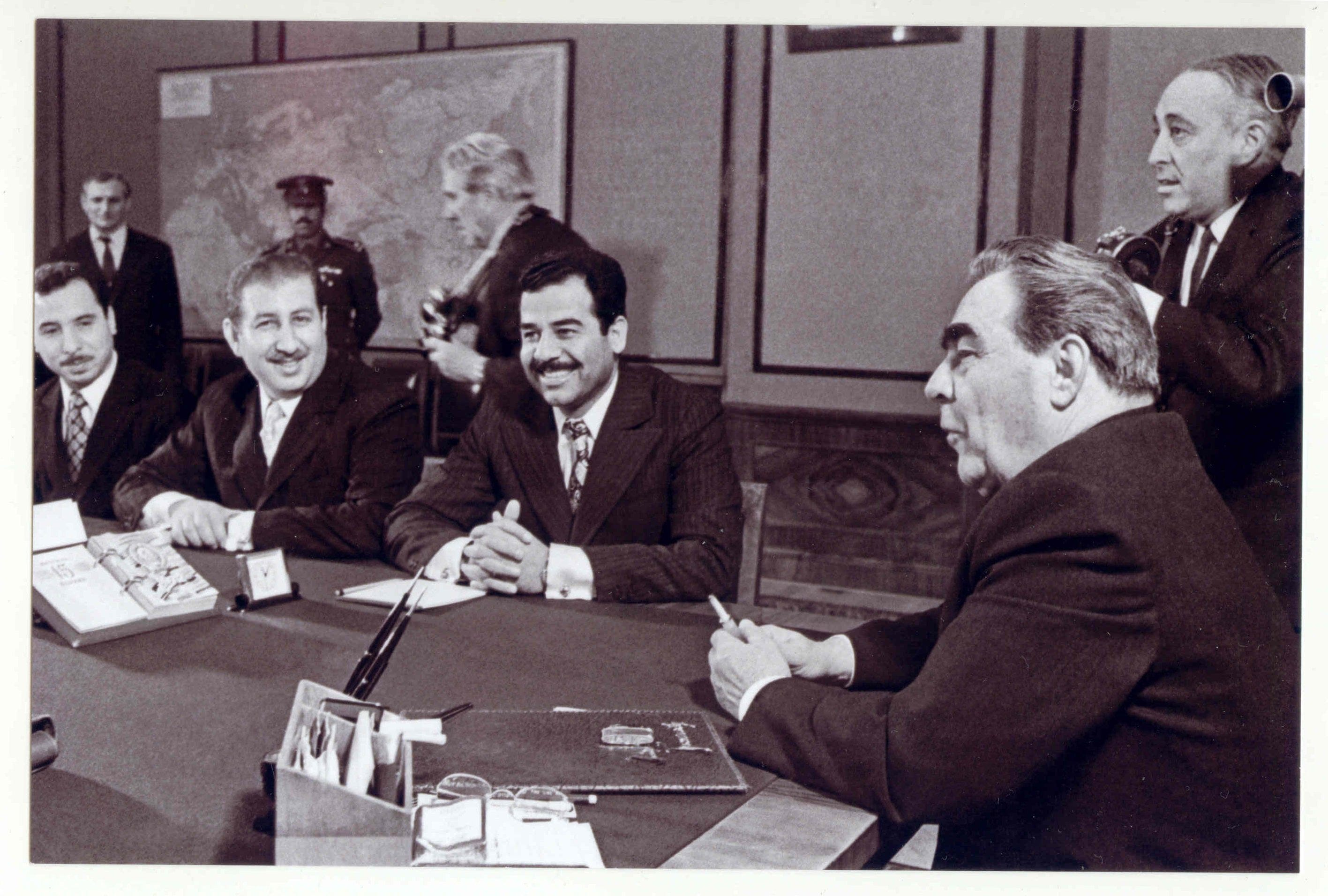
And today, both regions are in disarray. Modernist striving has disappeared, replaced by various forms of identitarianism. The main ideological struggle in both contexts has long been that between sovereigntists and the NGO community. The Arab NGOs call their opponents ‘corrupt Iranian stooges’ or simply ‘dictators’, the sovereigntists call the NGOs ‘anti-national Zionist/American running dogs’ who lack any strategy of national development beyond neoliberal economic reforms.

What the future heralds is unclear. In Beirut, tattered USAID posters remain everywhere. But the agricultural equipment has been abandoned, the NGO funding all dried up since Trump’s axing of the agency. I am told that the footsoldiers of the old NGO ecosystem, once confident enough to undertake a thoroughly failed ‘maidan’ uprising in 2019, are now entirely cut adrift.
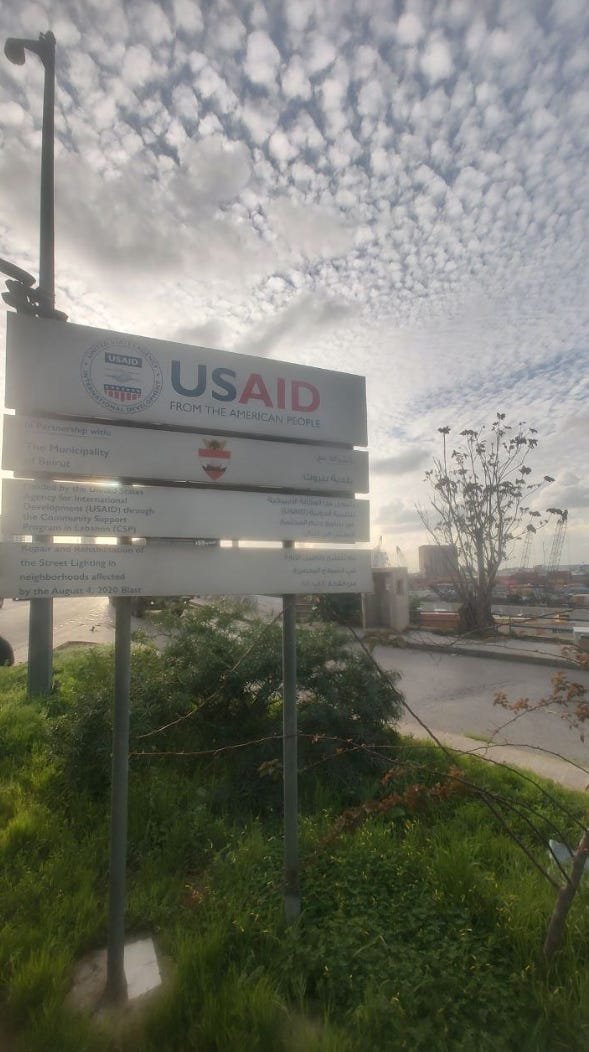
As for the present, it is rather bleak. War. Cities that feel like a warzone without war thanks to the lack of urban planning. Not just economic stagnation, but economic regression. A younger generation whose main priority is to escape to the west. One could call this the postmodernity of the global south.
So now, onto my past ten days traipsing about Lebanon. I’d always wanted to visit an Arabic country. I read a few books about Hezbollah a few years ago. Beirut often shows up in spy novels. And the city is filled with old friends of mine. Along with that, I’ve encountered a delightful cast of journalists, NATO spooks, unnamed diplomats, and a number of eclectic and entertaining locals. Though I visited far too few locations in this small but diverse country, there were enough memorable trips.
I won’t be talking about all my experiences here today, nor will I in future. But what I can talk about should be interesting as well.
And most importantly, I feel a sort of deja vu here. February 24 is rapidly approaching, a day that will always live in my memory. And here in the Levant, a US strike on Iran along with an Israeli invasion of southern Lebanon seems imminent. But then as now, catastrophic threats don’t seem to worry people as much as one might think.
