Trump's transformation?
The Russian tanker affair. Moscow's deterrence problem. London's intrigues. Pyongyang or Alaska?

Trump has continued to make good on his elections promises since his Caracas excursion. On January 7, he called for an increase in the military budget from $1 trillion to $1.5 trillion. That’s what it takes to build America’s ‘dream military’, the one ‘we have always been entitled to’.
In response, Tucker Carlson reached the rather reasonable conclusion that the US is preparing for a gargantuan war. In his usual fashion, he argued that a ‘relationship with Russia’ is necessary if the US is to receive the resources it needs to survive the imminent ‘world war’.
Of course, the war that Republicans — and the rest of the American security establishment — are most focused on is that with China. But what about Trump’s supposed peacemaking with Russia, Beijing’s key ally and energy supplier?
Carlson represents the line of thought that the US get Russia on its side — or at least neutral — in preparation for the showdown with China.
But the way things are going, it seems more likely that the US will go to war with both Russia and China.
However, the fecklessness of Russian responses to recent American provocations — and the absence of much of a Chinese one either — make the outcome of this struggle somewhat up in the air. I can imagine Trump thinking that if his good friend Netanyahu can fight seven conflicts simultaneously, then why can’t he?
After all, Washington seems to be increasingly tired of diplomacy. perhaps a change of instruments is incoming. We’ve endured a year of Trumplomacy vis a vis Russia and Ukraine. With the war continuing as usual, it’s hard to avoid the suspicion that it’s all been a waste of time.
To be fair, Zelensky began the year with his usual total rejection of any abandonment of the 1991 borders. By December, Ukraine began officially accepting the withdrawal of Ukrainian troops from parts of the Donbass — but only as long as it is a ‘demilitarized zone’ where Russian troops are also not allowed. That must be some progress, right?
But come 2026, and things seem to be changing. Not exactly towards a ceasefire.
There are many signs of this change. One is the fact that there have been no new exchanges of prisoners of war between Russia and Ukraine since October 2025.
Strategies shifting?
The Euro-Ukrainian plan has always been to propose ‘peace compromises’ that they know will be rejected by Moscow, so that Trump gives up on the possibility of peace with Russia. This would thereby re-enlist Washington as an enthusiastic sponsor in the war against Russia.
Despite high-flung phrases of the ‘spirit of Anchorage’ following the Trump-Putin Alaska meeting in August 2025, peace talks are moving at a snail’s-pace, if at all. Is the European mission of transforming Trump finally working?
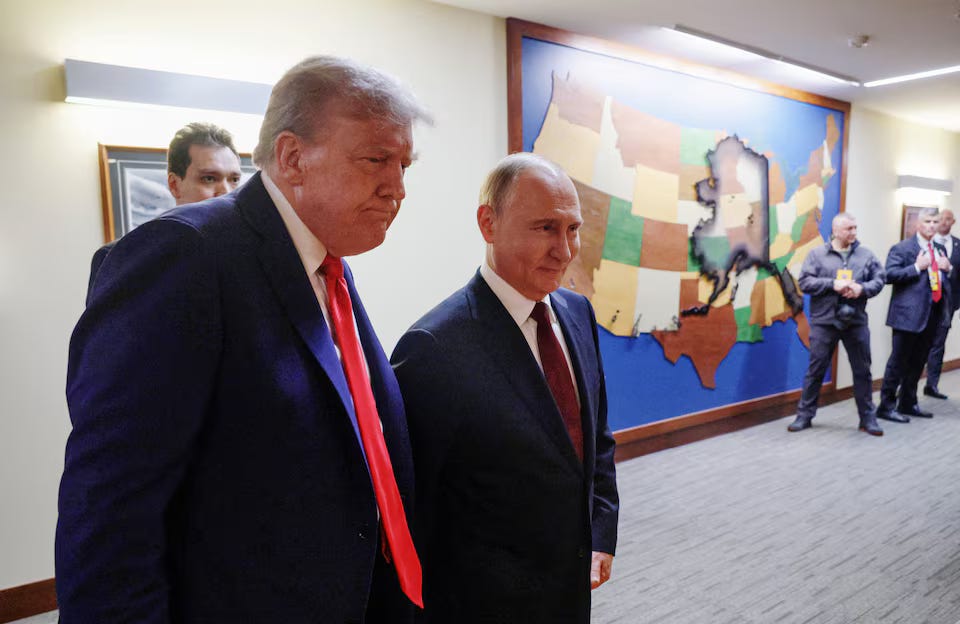
Trump has already stated his ‘disappointment’ with Putin at numerous points throughout 2025. However, this never actually led to Washington increasing military aid to Ukraine.
Nevertheless, with Moscow unwilling to bite on an American peace plan that would leave Ukraine’s army three times larger than it was before 2022 and satisfy few of Russia’s territorial demands, Trump has once again become frustrated. On January 4, fresh off the high of his Venezuela operation, Trump announced that he was tired of Putin’s unwillingness to agree to US demands:
I'm not thrilled with Putin. He's killing too many people
Trump said this at a press conference dedicated to his kidnapping of the Venezuelan president. It’s quite clear indeed that Washington intends its show of force in Caracas to be a sign to all its enemies. Trumplomacy is becoming ever more enthusiastically aggressive.
For instance, the following January 4 State Department post was clearly not merely addressed to Venezuela, but other countries that Trump wants something from. Of course, it is from Russia that Trump most desperately wants something — agreement to a compromise peace deal that the Kremlin doesn’t think it needs to sign.

Tanker turning point?
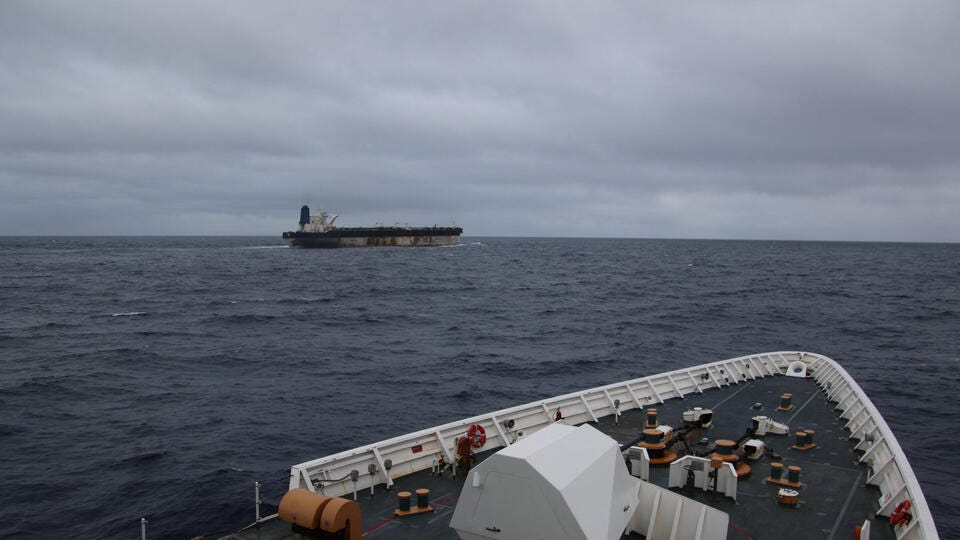
Unprecedented events are certainly transpiring. On the 7th of January, a joint US-UK mission seized control of the Marinera, a Russian oil tanker. Washington justifies itself by claiming that the tanker had violated its unilateral blockade on Venezuela.
I’ll begin by examining exactly what has happened with the ship over the past week. London’s participation in the operation is particularly tantalizing, raising the prospect that the UK has succeeded in pulling the US back into Europe against Moscow. We’ll then examine how British, American, Australian, Ukrainian, and Russian media and officialdom has commented on and interpreted the entire affair.
While the American and Australian press is excited that Trump appears to be going on the warpath against a weak Russia, British media is worried that it is all another farcical performance. Ukrainian diplomats, politicians, and bloggers are naturally overjoyed by the incident.
The Russians are downcast. Disappointed by the official response, military bloggers have been discussing a range of possible approaches towards preventing such events in the future, as well as the problematic disparity between Russian and American deterrence tools. Instead of the spirit of Alaska, many are calling for the spirit of Pyongyang and Sanaa. In the words of one analyst:
The notorious ‘spirit of Anchorage’ is not only dead, it stinks like a half-decayed corpse.
Faced with this deadlock, Russian analysts propose a range of possible options for deterring the western march towards a full-scale, Lyndsey Graham-style oil blockade on the US, a form of sanctions that would be far more damaging than anything before.
Tanker timeline
Trump began his naval blockade of Venezuela in December. And two days ago, it turned out that this blockade extends to the icy waters of the north Atlantic, where the Russian Marinera tanker was captured.
The Russian foreign ministry first reported on the Marinera tanker on January 6:
For several days now, the tanker Marinera has been followed by a U.S. Coast Guard vessel, even though our ship is about 4,000 kilometers away from the American coastline.
The foreign ministry emphasized that the ship was travelling in the international waters of the north Atlantic under a Russian flag.
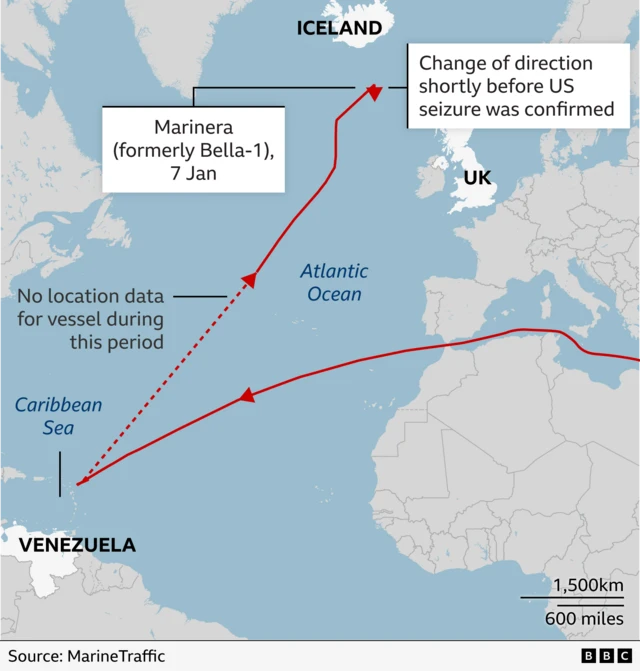
Russian military telegrams reported that the Marinera was on its way to the Russian port of Murmansk. It had apparently been pursued by American P-8A Poseidon planes for two weeks. It was seized in bad weather, with wind of 20 meters per second, water temperatures near freezing and waves of five meters.
A video from the Marinera's perspective seemed to show one of the U.S. Coast Guard’s largest ships following it — a ‘Legend’ class. Russian media also claimed it was also followed from the skies by a British RC-135W Rivet Joint surveillance plane:
And on January 8, a black hawk helicopter began hovering over the Marinera:
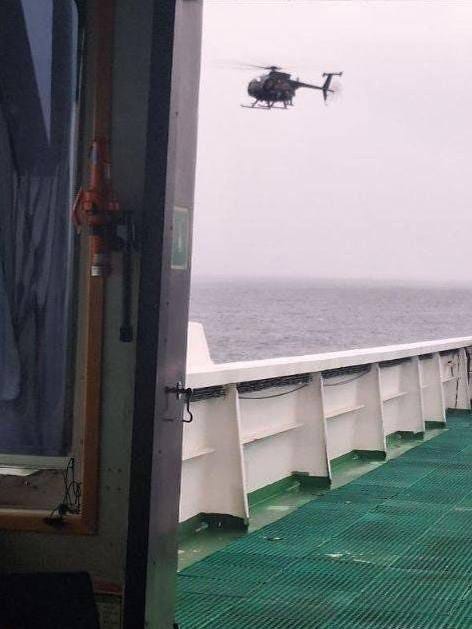
The Americans soon released videos of their landing on the tanker. Around twenty soldiers entered the ship from a S-70 Black Hawk helicopter. They headed towards the crew’s cabin, though the ship’s men refused to let them in.
At this point, it’s worth noting who these brave crew members were. The Russian media source REN TV reported that of the 28 crew members, only 2 were Russian citizens — 17 were Ukrainian citizens, making it the most well-represented nationality on board. This isn’t uncommon, with work on ships a highly lucrative and popular option for Ukrainian men.
It seems the majority Ukrainian crew didn’t want to give up the Russian ship to the Americans without at least some resistance. Which is much more than can be said for the Russian naval submarine supposedly protecting the ship! But more on that later.
Anyway, faced with no armed resistance, the Americans broke down the door to the cabin with shots from pump-action rifles.
REN TV had this to say on the context of the Marinera’s capture:
