A pissing war
August war development. Rapid worsening on Dobropillia/Druzhkivka directions.

The manpower deficit is so severe that Ukrainian troops at frontline positions have to drink piss to survive. Not only are there insufficient troops to replace them, but it is extremely dangerous to rotate due to Russian drones.
This is what we learned from a video released to social media by soldiers in the 121st territorial defense brigade on August 11.
The fighters directly addressed the new commander-in-chief Mikhailo Drapaty, complaining that the lack of rotations, food and water is forcing them to drink urine to survive’. The platoon commander says that he and his troops have been fighting in the Zaporizhzhia oblast area since April, even though they were promised monthly rotations. Sometimes his soldiers have to go without food and drinking water for three to seven days. They also lack medications. Dehydration has caused some soldiers to become semi-conscious.
Despite this, the platoon commander has been told by superiors that logistics in his area have been established. In reality, clearly, this is a lie. He says that after his unit’s initial positions were destroyed, they had to hid in improvised shelters. Furthermore, his unit’s Starlink terminal was destroyed by Russian drones. He officially requested command to resolve the communications issue multiple times, but received no response. Communications were only recently restored thanks to civilian volunteers.
This is what the official Facebook page of the 121st territorial defence brigade wrote about the situation on August 11. They vaguely denied some of the claims by the troops while also admitting that the situation is very bad.
We understand the concerns of the servicemen, support each of them, and together with them are working through the difficulties that have arisen. The brigade commander personally communicates with the servicemen and is aware of the situation that has developed.
The information voiced in the video address does not reflect all of the circumstances.
At the same time, we would like to emphasize that the brigade command is doing everything possible to rotate the personnel as soon as this can be done safely for the lives and health of the personnel. It is currently important not to expose the defenders to additional danger during movement.
Frontline overview
Many hold high hopes about the new commander-in-chief (CIC) Drapaty. But with the way that the frontlines are going, that hopes might soon transform into bitter disappointment. Perhaps that was precisely Zelensky’s calculation in appointing the worryingly popular Drapaty.
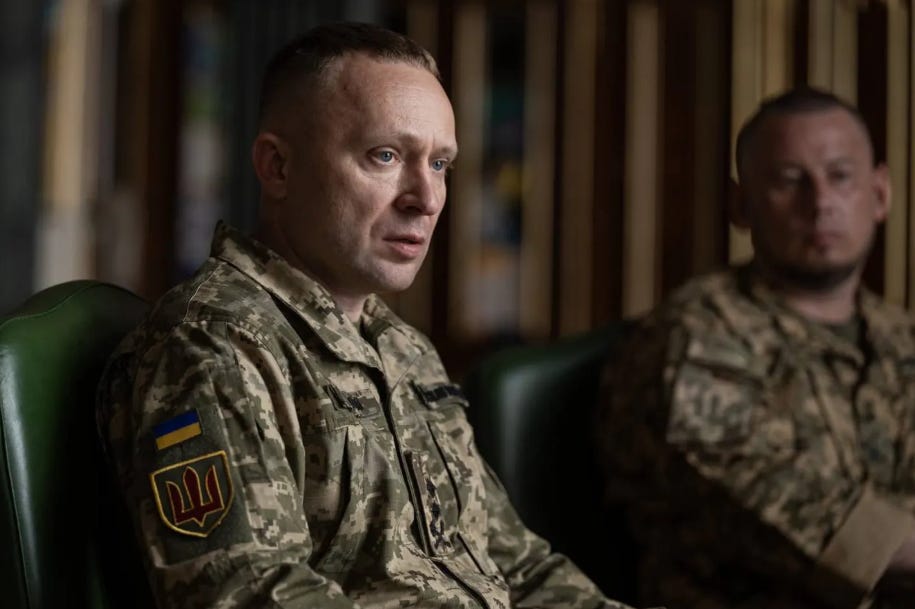
The conventional narrative is that ex-CIC Oleksandr Syrsky created ineffective assault units that wasted inordinate numbers of personnel to little effect. Meanwhile, ultra-effective superwarriors in the Azov 1st and 3rd Corps are singlehandedly keeping the front semi-stable while taking nearly no losses, along with the airborne assault forces.
Given that the only person I know killed in the war was precisely in the 3rd Azov Corps, I find such a black and white picture somewhat unconvincing.
Let’s now turn to the only Ukrainian source on the war worth reading anymore, Muchnoy Jugend, a soldier in the airborne assault forces.
Muchnoy was quite worried about the direction of the war in his August 2 post. He seems to be implying that Drapaty’s appointment is unable to solve the fundamental problem of lack of manpower. He is also concerned that all the public hatred against Syrsky and constant mediatized scandals about the assault forces have weakened public trust in the army. His reference to ‘well-known brigades’ with good PR that are not able to handle the situation properly seems to be a reference to the 1st Azov Corps, given the major Russian advances in the Dobropilya area the past two weeks. Finally, his reference to units with ‘a controversial reputation’ that actually often save the situation is probably a reference to the 425th and 225th assault regiments. If they really are being disbanded due to their renowned brutality (more on which in an upcoming post), this probably spells serious issues for Ukrainian defensive capabilities. Here’s Muchnoy:
In my view, the situation at the front is gradually becoming more difficult, and this is increasingly evident in the shortage of personnel and resources in certain areas. As a result, decisions that look like measures of necessity are beginning to be made: instead of fully replenishing units, personnel are being gathered from different brigades, creating a kind of “hodgepodge” that is then redeployed to cover particular sectors. At the same time, reinforcements do not always go to the areas where the situation is most critical.
It is also telling that even some well-known brigades that receive extensive media coverage are not always able to handle their areas of responsibility on their own. As a result, other units have to be brought in to stabilize the situation, including units that are often criticized or have a controversial reputation in the information space. This once again demonstrates that the real situation on the battlefield is considerably more complicated than the public picture suggests.
The situation in the rear is also worth mentioning. In my opinion, internal political conflicts, public disputes, and symbolic actions during a full-scale war only distract attention from what really matters. At a time when the front requires maximum concentration of forces, resources, and social unity, any internal confrontation only weakens the country. After the emotional debates and loud statements, we still have to return to reality, where the most important thing remains one thing — helping the front, supporting the military, and working together to achieve results.
“Please, don’t engage in fucking bullshit. Let’s defeat the enemy first, and then we can beat each other in the fucking face with chairs while sorting out our differences. For fuck’s sake!”
Muchnoy’s August 11 post was even more despondent:
I’m scared to write anything to you today. I’m sorry, but this is just fucking hell. The situation is so difficult and tense that I don’t even want to try to find the right words or pretend that everything is under control.
Too many problems have piled up at once recently, and now we’re seeing the consequences. I don’t want to unnecessarily alarm people, but I don’t want to hide the obvious either. The situation is serious. Very serious.
⌛️

Let’s now see why exactly Mr Muchnoy is so sad. His multiple daily posts on the front are partly based on his own experiences and contacts, and partly on analyses of Russian videos of their presence in various settlements.
In short, Sloviansk and Kramatorsk continue to be surrounded from the northeast (Raihorodok/Starodubivka) east (Mykolaivka/Vasiutinske), south (Druzhkivka), and southwest (Dobropillia). Once Sloviansk/Kramatorsk, these final cities of the Donbass are taken, the question of the war’s continuation of conclusion will be fully raised. After all, Russia has generally stated that these are its main territorial demands vis a vis Ukraine. But to be honest, I somehow have the feeling that the war won’t over after they’re taken.
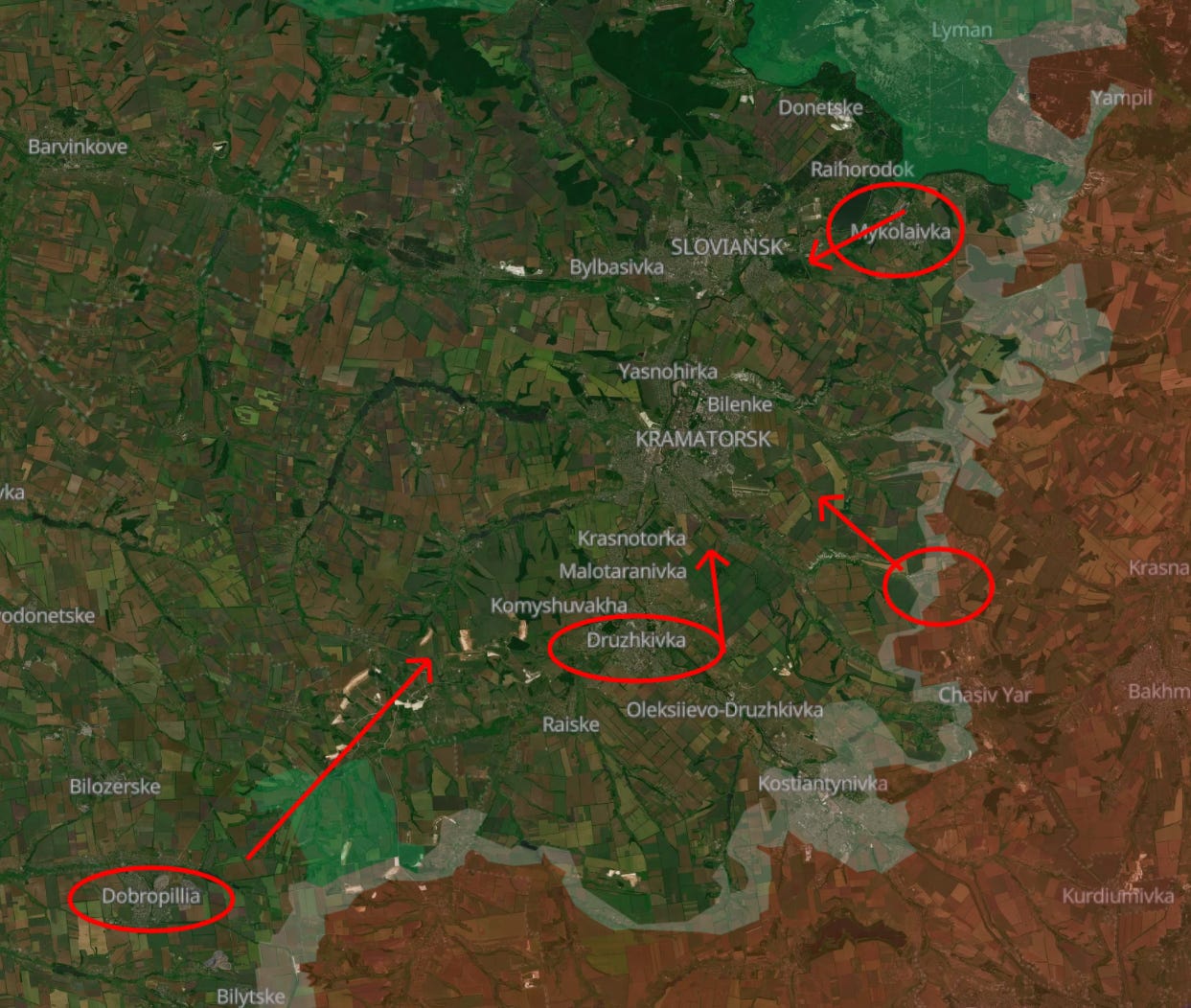
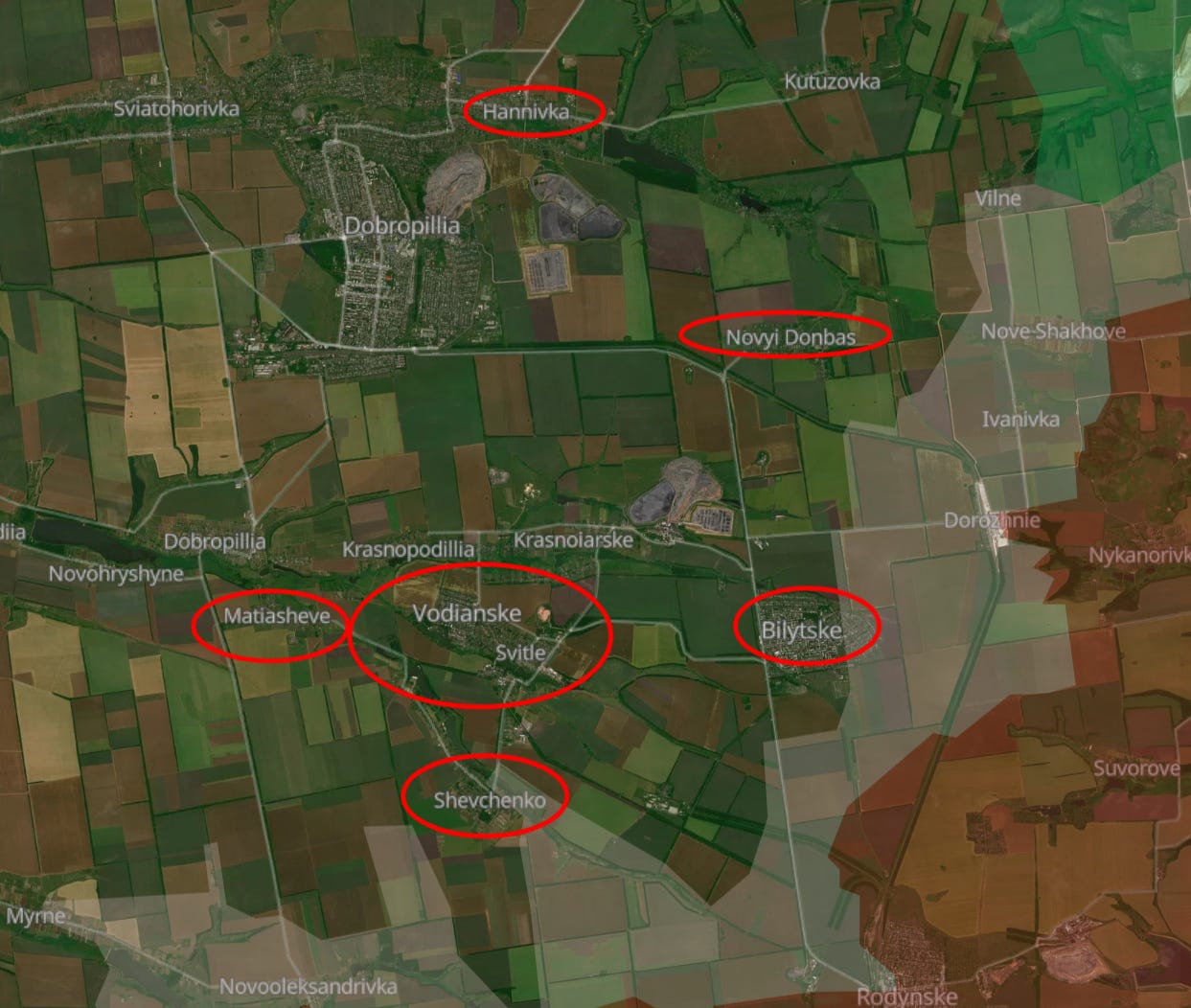
Muchnoy predicted in late July that August would be ‘one of the most intense periods in recent times’, particularly for the Dobropillia and Druzhkivka areas. And it certainly has been. Russian troops have entered and consolidated control over a number of villages around Dobropillia, and are now conducting assaults into Dobropillia itself. So much for the unbeatable Azov. These are the villages Muchnoy says the Russians have now consolidated control over during the past two weeks — the massive lag of DeepState’s map is very evident.
Druzhkivka, meanwhile, is increasingly surrounded. On July 31, Muchnoy concluded that Kostiantynivka had definitively ‘broken away’ from Ukrainian control, with Russian forces now entering Osykove and Oleksiievo-Druzhkivka, to the south of Druzhkivka. The last Ukrainian positions in Chasiv Yar seemed to fall in late July, opening up Oleksiievo-Druzhkivka from the southeast. Ukrainian forces inside Druzhkivka are being increasingly targeted by Russian drones, along with logistics leading to the city from the north. A number of villages circled below also came under Russian control this month, after a prolonged period under contestation.
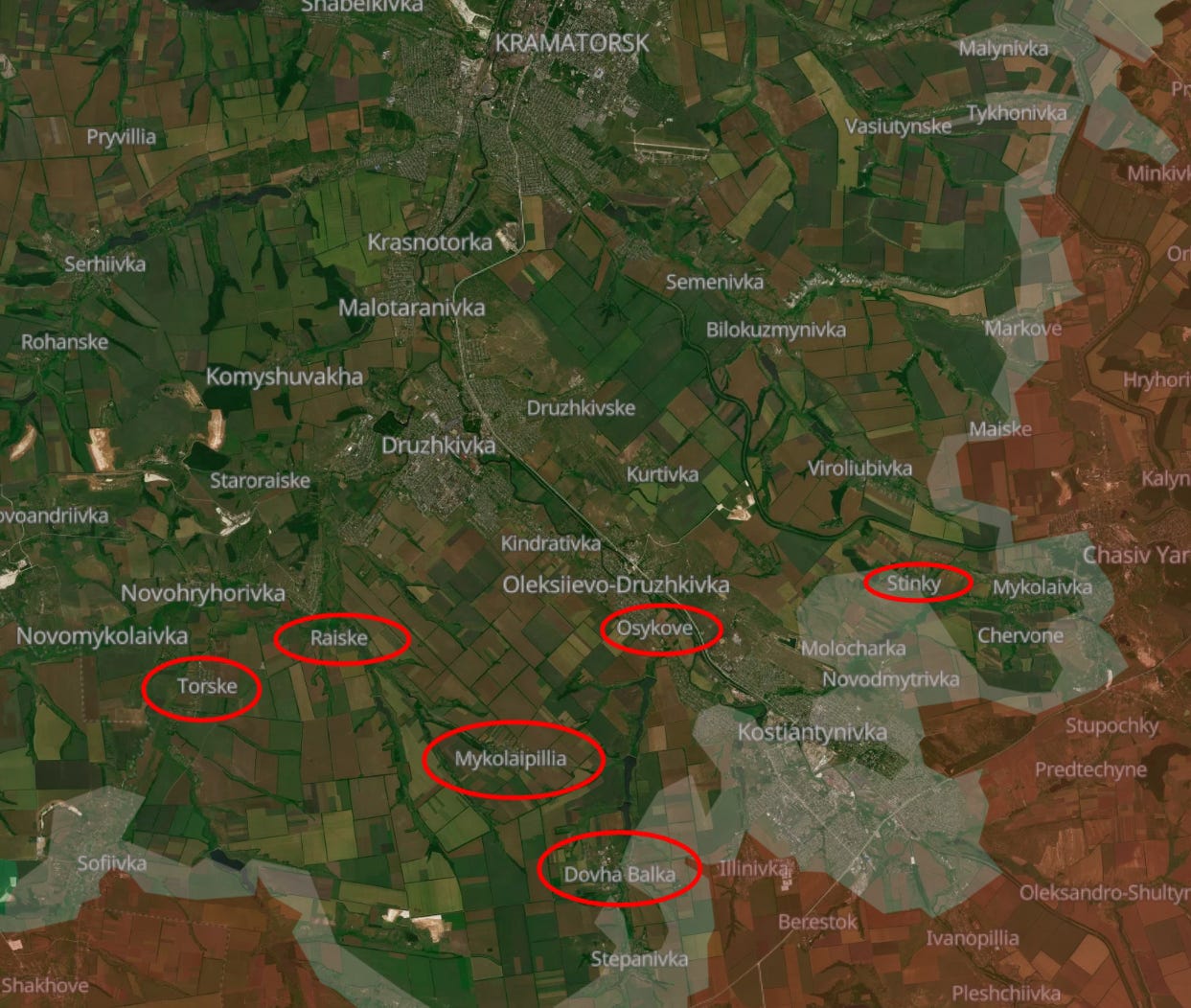
Muchnoy writes that around Druzhkivka and Dobropillia, a Russian strategy of advancing on a wide front from two sides without concentrating on a single settlement is being increasingly witnessed. This simultaneous style of conducting offensives is stretching Ukrainian manpower. It also seems to indicate that the Russians aren’t exactly experiencing a catastrophic manpower deficit, as Zelensky and the western press claims, which is supposedly going to force Putin to declare a new mobilization.
Meanwhile, Zelensky declared yesterday that Ukrainian forces have retaken 740 square kilometers of territory in the agricultural terrain of the Dnepropetrovsk oblast. These counter-attacks have been taking place since the start of 2026. However, in reality, this looks like the same old story of constant contestation over unpopulated farmland. Muhnoy reports that a number of the village Zelensky claims to have been retaken are actually still being fought for. The area itself lacks any strategic importance other than as a distant gateway to Ukraine’s southern cities. Russia’s attention is on the Donbass, which is where the big advances have been recently.
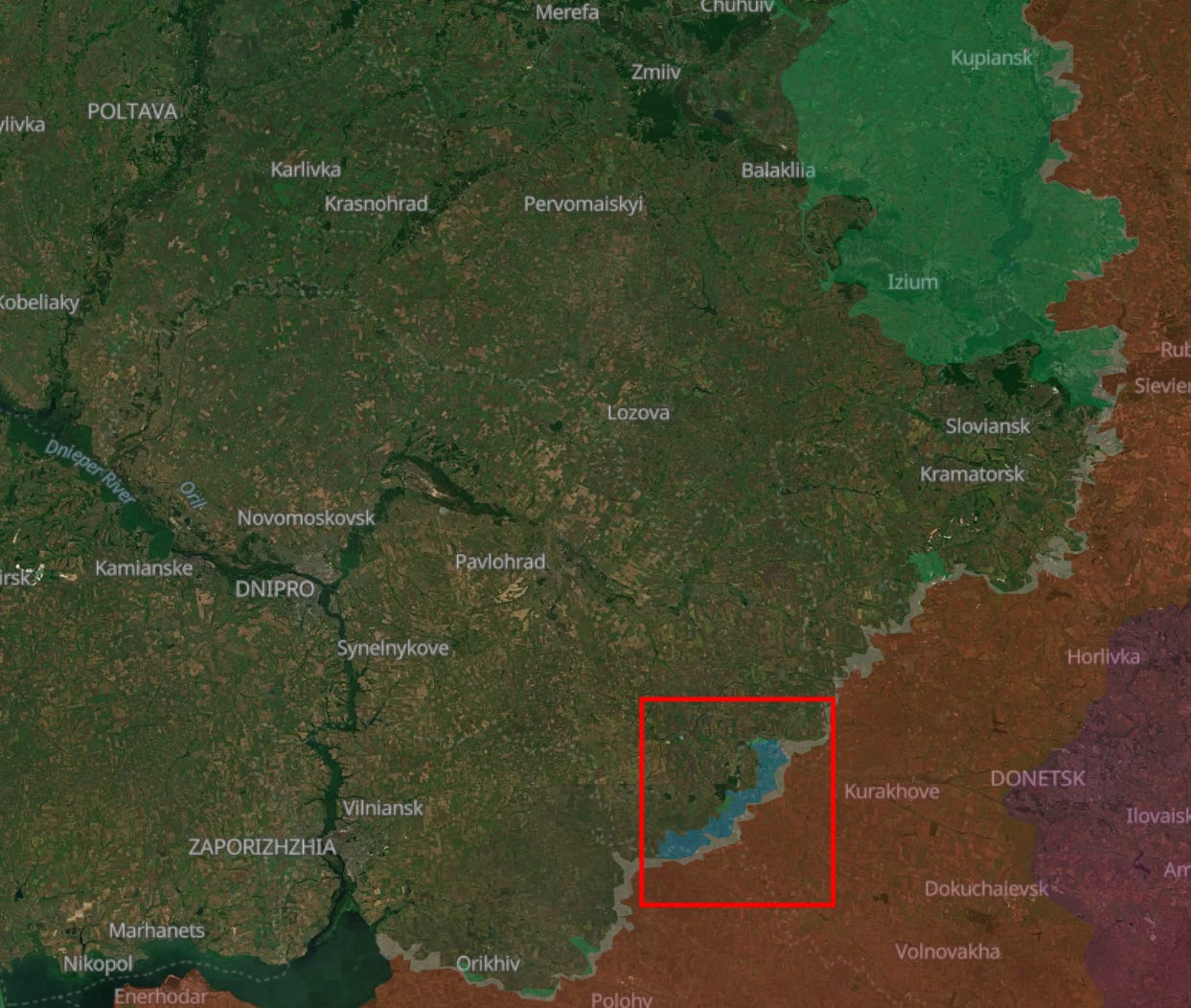
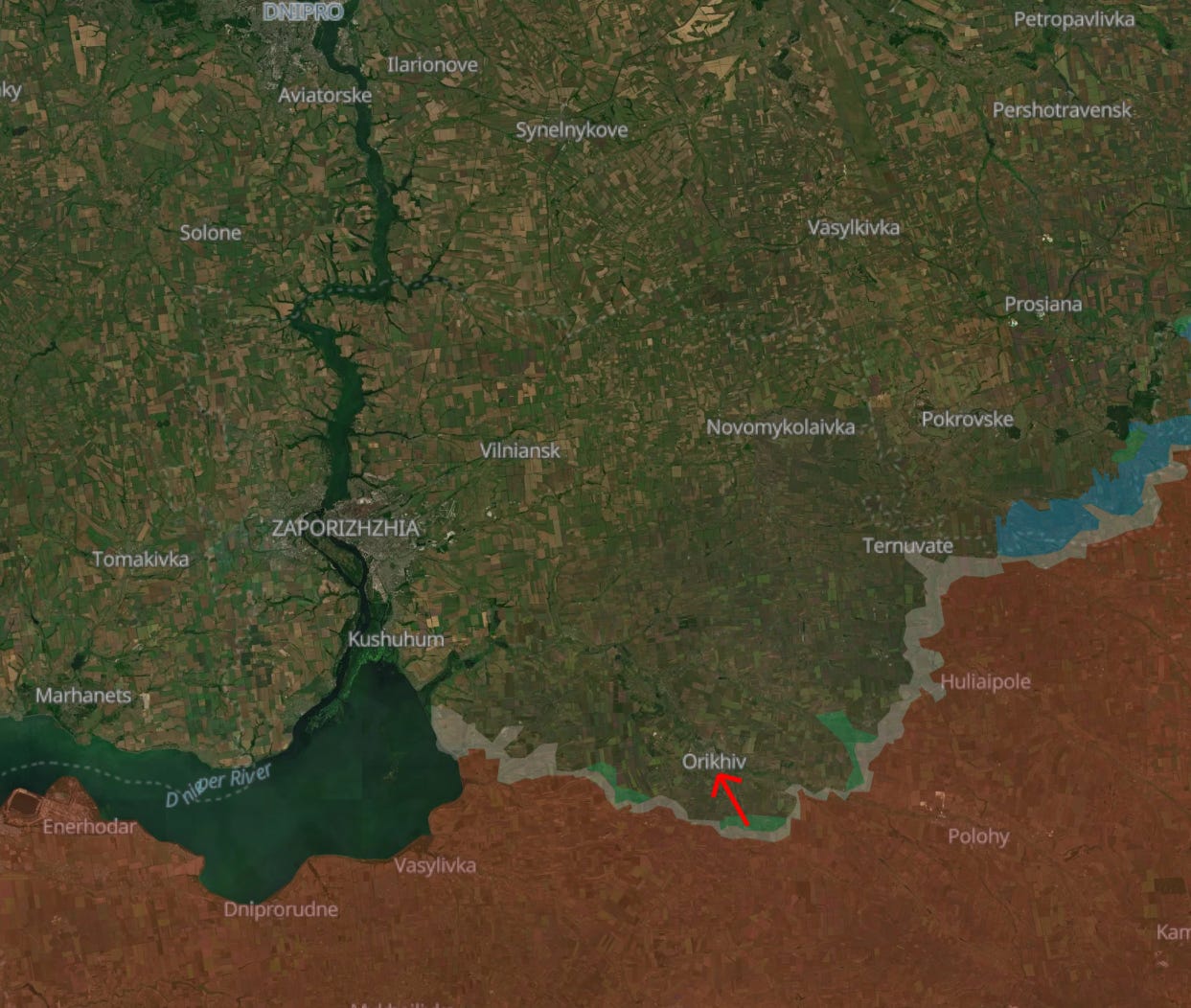
And even in the south, in the Zaporozhzhia oblast, the Russians have contested villages such as Lubytske, Lisne and Danylivka. Russian forces apparently reached the eastern outskirts of Orikhiv on August 4, but did not seem to be able to consolidate. If they manage to take Orikhiv, this will finally allow them to develop their advance towards the massive industrial city of Zaporizhzhia, which has a population of around 700,000.
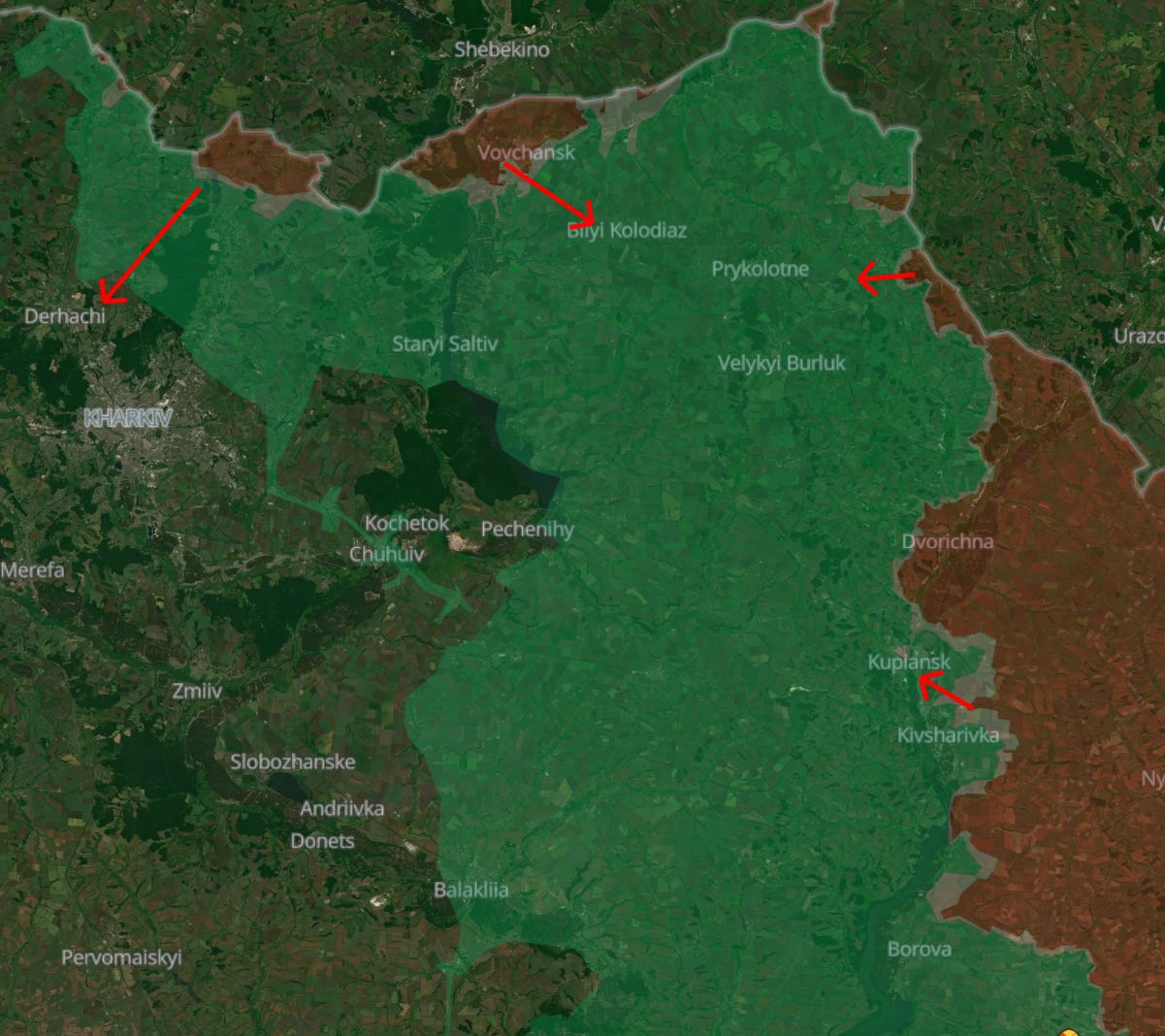
The Ukrainians are also facing a threatening situation in the north, the Kharkov oblast. The Vovchansk area is the most dangerous section of the Kharkov oblast for the Ukrainians, partly due to the complex forested ravine terrain protecting Russian infantry groups.