Palantir's laboratory
Views from Russians and Ukrainians

Palantir CEO Alex Karp has been effusive about Ukraine in recent interviews.
I like being in a place where people like us.
No wonder, if you have a look at Palantir’s recently released manifesto. In it, the company called for universal military service, the re-militarization of Germany and Japan, a solution to violent crime by Silicon Valley, and the replacement of nuclear deterrence with AI-powered weaponry.

If there’s any country that embodies his ideals of total militarism with the airs of technological futurism, it’s Ukraine. Israel, too, of course, but I suspect the Israelis are somewhat less transparent and enthusiastic to act as labrats.
Palantir’s love for Ukraine is telling. They see the future for the west in Ukraine. I’ve also always had this opinion — the world, or at least the west, is most certainly Ukrainizing. Militarization and criminalization of incorrect speech acts is already widespread. The next step is state-supported paramilitaries and closed borders.
Ukraine also shows how despite all Palantir’s technological fetishism, wars are fought with human bodies.
PR employees of defense minister Mikhailo Fedorov, Palantir’s key ally in Ukraine, like to talk about how futuristic drones will obviate the need for unpopular mobilization. But instead, at the same time that Ukraine’s cooperation with Palantir has deepened, mobilization has intensified.

Flashy drone strikes on Russia are one way to convince western audiences that the war is being won. But territory isn’t regained with drones, only with high-casualty assault units. Hence the constant expansion of these infamous units in recent months.
There have even been some open conflicts in the Ukrainian press between the generals supporting the infantry assault approach on the one hand, and Fedorov’s nerdy drone fetishists on the other. It seems somewhat for show — the Fedorovites want to look like they care more about human life, when in reality they are quite fine with ever-increasing tempos of mobilization. They aren’t the ones being drafted.
Transatlantic friendship
On May 12, defense minister Fedorov met once again with his dear friend, the richest African-American on earth — Alex Karp.
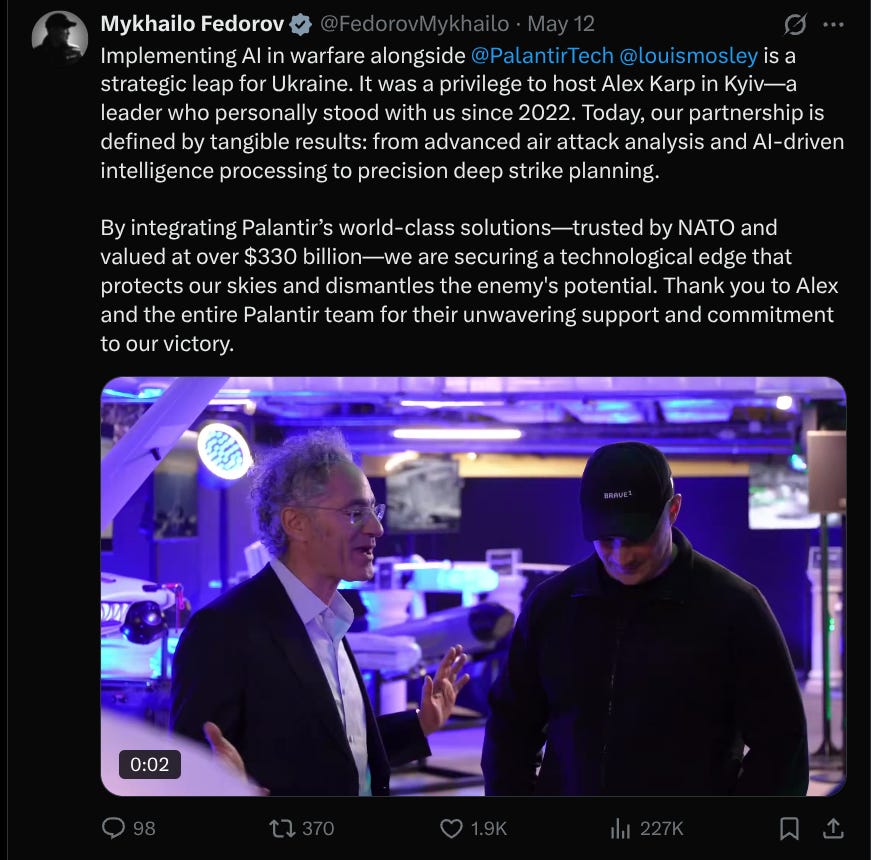
Along with Karp, Fedorov thanked Louis Moseley, head of Palantir’s UK operations. Moseley is the grandson of Oswald Moseley, leader of Britain’s Fascist Party. Moseley got into serious arguments with fellow fascist ideologue Francis Yockey due to Yockey’s opposition to collaboration with NATO. How time flies.
In his telegram post, Fedorov was more detailed about the nature of cooperation with Palantir since 2022:
🔹 we created a system for detailed analysis of air attacks;
🔹 we implemented AI solutions for working with large volumes of intelligence data;
🔹 we integrated technologies into the planning of deep-strike operations.A separate area is the Brave1 Dataroom, created jointly with Palantir. This is a platform where developers gain access to real battlefield data to train AI models. More than 100 companies are already training over 80 models for detecting and intercepting aerial targets in difficult conditions.
These ‘aerial targets’ are Russian ‘Geran’ drones, usually called ‘Shaheds’ in the western press.
On May 13, Fedorov called Ukraine ‘no longer just a shield, but the global R&D hub for modern warfare.’ This is probably his favorite slogan of all.


On May 13, right as Karp was visiting Ukraine, Republican senator Mitch McConnell checked whether Pete Hegseth was willing to keep the US involved in this delightful ‘silicon valley war’:
McConnell: Army secretary Driscoll has described Ukraine as the Silicon Valley of warfare. I think we all agree on that. And the outcome of the war really matters to American interests. Is there a policy preventing senior American officials travelling there? Do you support of oppose American officials travelling there?
Hegseth: We’ve had many senior officials travel there, and we’ve learned a lot. In fact, I’ve personally approved additional personnel there to learn from that drone battlefield — both on offense and defense — to ensure that we’re learning every possible lesson from that conflict and incorporating it in real time into how we defend and how we go on offense in an era where drone dominance is required.
And that’s why this budget spends so much on drone dominance: to take the lessons learned from Ukraine and other battlefields and ensure we’re applying them throughout the fighting force as quickly as possible.”
I’m not surprised Hegseth has been sending US military experts over. It seems increasingly hard to escape the suspicion that Trump’s supposed openness towards Russia and dismissal of Ukraine is a bluff to hide the reality — that Washington is escalating support for Ukraine’s army. The aim is to pressure Russia into agreeing to become a subordinate ally in the struggle against China.
And Palantir plays a major role in this strategy. First, in identifying targets for long-range Ukrainian strikes on targets deep inside Russia, like the large May 17 attack on Moscow. Second, for coordinating drone warfare at the frontline proper.
Many Russian bloggers are pointing out that negotiations with the Trump regime are contradicted by the actions of Palantir, or Starlink’s February 2026 decision to cut off access to Russian users. Meanwhile, thousands of Ukrainian drone operators use Starlink against the Russian army, with the Ukrainian army entirely dependent on it for communications. Trump’s America has chosen it’s side in this war very obviously — the only ones refusing to believe are American liberals, for good partisan reasons.
And in a May 13 interview by the German Die Welt, Karp excoriated Berlin for refusing to buy Palantir products, pointing to the excellent example of Ukraine. He says that Kiev’s armed forces have been using Palantir ‘like an operating system for war’. He boasts that this allows the battlefield to be managed ‘like a technology company serves its clients’:
The only difference is “how many Russian soldiers are killed per square kilometre? Why and how, what means were used, what worked and what didn’t?”

According to Karp, Palantir operates even at the level of individual units.
I suspect that he may be inclined to exaggerate Palantir’s use in the battlefield. After all, the point of the interview is to get the Germans to buy in. As we’ll see later in today’s article, it seems more accurate that Palantir is only used at higher levels of operational planning in Ukraine, with Ukraine’s own DELTA used at the tactical level (note that NATO was also likely involved in developing this platform).
Anyway, Karp also assures his German audience that Ukraine’s data is somehow being kept secure:
When they’re doing air defense or targeting, almost all the code is written by them, controlled by them. We have no access. In that sense, in my view, there’s no sovereignty issue. I couldn’t tell you what they’re doing, how they’re going, and I can’t stop them from doing it. They control that.
However, even Karp’s beloved ‘peeps’ in Ukraine aren’t all convinced.
