Starlink?
Analysis, reactions, predictions.

It’s been more than three days since Elon Musk turned off Starlink access to all those on Ukrainian territory not on the Ukrainian ministry of defense’s ‘white list’. Russian military bloggers are writing of 500,000 Starlink terminals switched off. Note that this includes a number of Ukrainian terminals that, for whatever reason, ended up switched off in the crossfire.
There are several paradoxes to ponder here. The first, of course, is why significant portions of the Russian army have been relying on NATO technology for communications. Another is why it took so much time for Ukraine’s political leadership to come up with the bright idea to simply ask its American partners to shut off access. And finally, how is it that despite Musk’s putative status as a nefarious Russian agent, he acquiesced readily?
But we’ll stick to more prosaic problems. First, we’ll examine how exactly the Russian army has been using starlink. Then, we’ll see how the Starlink restrictions have negatively affected the Ukrainians themselves, as well as what both the Ukrainians and Russians have to say about the future of Russian communications and current solutions. Our look at Russian reactions will include some speculation about the political motivations of the Prigozhinites, who are most pessimistic about the Starlink cutoff.
Finally, we’ll take a look at several possible geopolitical interpretations of the implications of this story, and what this means for the future of the war.
The use of Starlink
There are conflicting reports on just how important Starlink is or was for the Russian military. At any rate, judging by the fact that restricting access to Starlink certainly has not led to a Ukrainian military breakthrough, Russia’s dependence on it was clearly not as critical as some may have hoped. Claims of a ‘catastrophe’ for the Russians, as made by advisor to Ukraine’s minister of defense Sergei Bezkrestnov, have not been reflected by the frontlines. As usual, all that happened was more gradual Russian creeping forward.
Of course, there do seem to have been some concrete results. Ukrainian general staff tell the media that the number of Russian assault operations declined on February 5. On the southern Zaporizhzhia front, there were apparently no assaults at all. Russian military blogger Colonelcassad confirmed the slowdown in military activity.
However, while the popular Ukrainian military blogger Tsaplienko wrote that same day that his sources confirmed the above information, they have also experienced an increase in Russian drone attacks. This was reported on various sections of the frontline. Starlink was never something that more than a minority of Russian military units used.
Indeed, most Russian military telegrams write that around 10% of their military communications relied on Starlink.
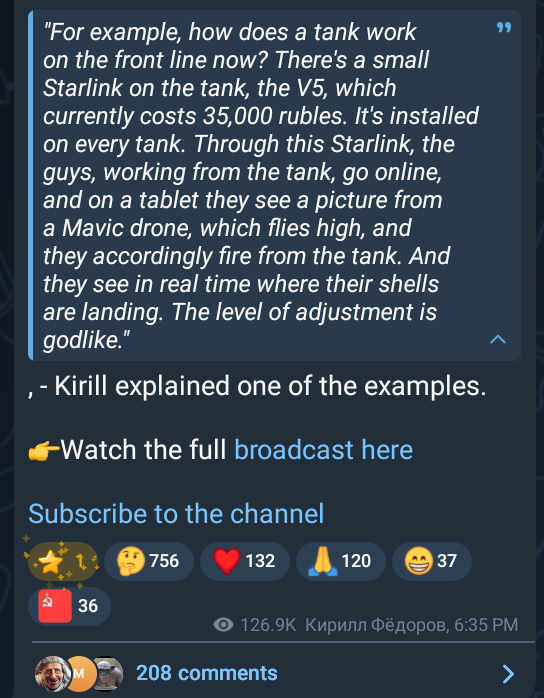
What was it used for? The past few months, I’ve been covering the damaging long-range drone strikes on Ukrainian logistics carried out by Russian drones supported by starlink. The military blogger Kirill Fedorov explained the importance of Starlink for the Russian army on February 1: