From drones to nukes
Ukrainians winning UAV war? Mushroom clouds soon?

According to Russian military journalists and drone experts, Ukraine has regained dominance in the drone war. Throughout 2025, all one could hear was Ukrainian commanders complaining about how Russia had far more drones and used them more effectively. There are still voices in Ukraine saying this. But in Russia, a number of relatively influential figures see things differently. Things are so bad, they say, that it’s time to press the big red button. Errol Musk is involved.
Long-range strikes
First, the most well-known reasons for Ukrainian gloating and Russian dooming.
It’s so over! Russia is begging for mercy! Ukrainian drone strikes on the key Russian port of Ust-Lunga jeopardize up to 45% of its crude oil exports!

Well, it turns out that the late March Ukrainian strikes on the Russian Ust-Lunga port didn’t exactly strike a knockout blow.
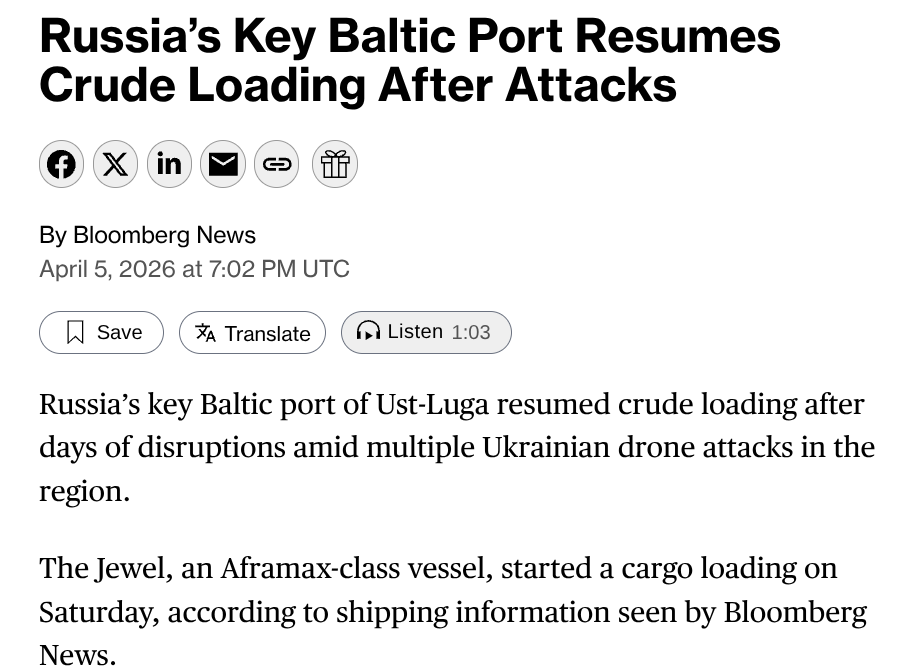
In fact, already on April 2 Bloomberg reported that the station wasn’t quite so damaged as the dramatic photos of burning infrastructure had indicated:
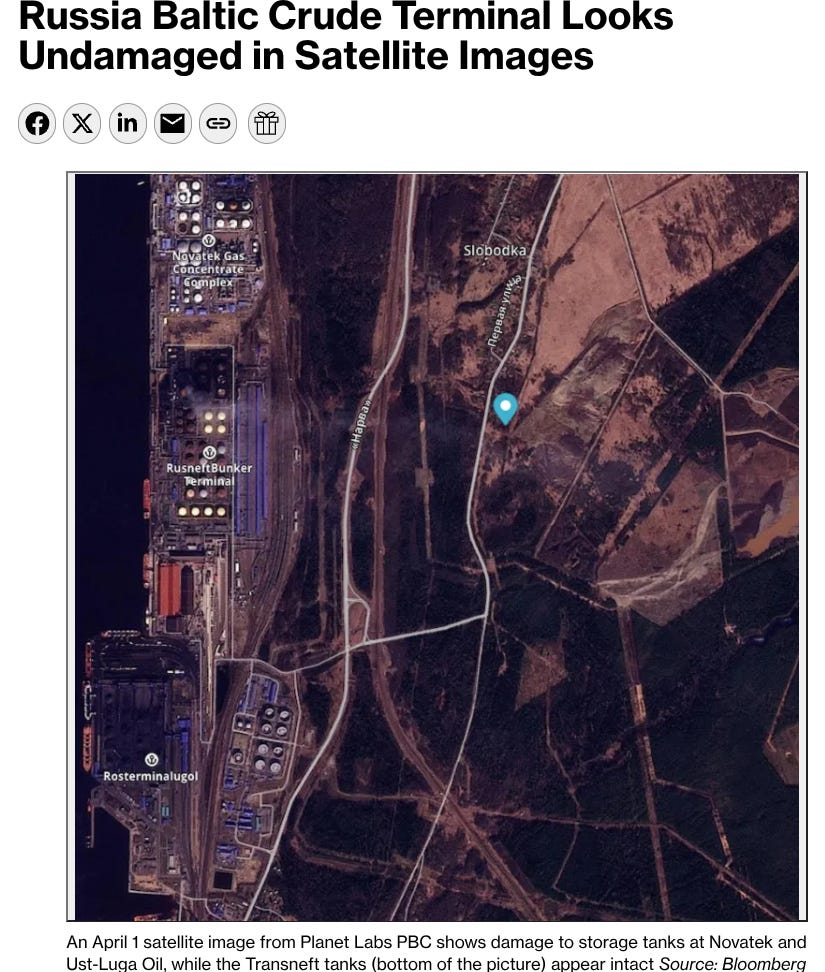
I’ve always been skeptical about claims from either side that the war can be won by air strikes on enemy infrastructure. Russia has far more missiles and drones at its disposal, yet it has still failed to destroy Ukraine’s energy infrastructure, despite trying quite hard to do so for several winters. Soviet infrastructure is quite hardy, and repairs allow even a damaged system to chug along.
For his part, head of the presidential administration Kyryllo Budanov claimed on the 5th that Ukraine’s western partners told them to top driving up energy prices through these strikes on Russian energy infrastructure. Another stab in the back. One more strike, and they would have marched into Moscow…
Of course, it’s not clear how true this is, given that there was another Ukrainian strike on Russian energy infrastructure on April 6, this time against the Sheskharis oil terminal in Novorossiysk.
That same day, the Russian government stated that Ukrainian drones attacked the nearby Caspian Pipeline Consortium’s Black Sea terminal, which handles 1.5% of global oil supply. Reuters called the strikes ‘among the most significant on Russia’s Black Sea export facilities’ of the entire four-year war.
The Russian government, in turn, tried to make Ukraine appear a rogue danger to the Washington:
‘The Kiev regime deliberately attacked facilities of the international oil transportation company Caspian Pipeline Consortium in order to inflict maximum economic damage on its largest shareholders - energy companies from the United States and Kazakhstan’
Surely the Russians don’t really think that the ‘Kiev regime’ is acting independently of its sponsors? But perhaps they do, perhaps they do… The Anglo-atlanticist press is also pushing this narrative of Ukraine ‘defying the west’ with these latest drone strikes.
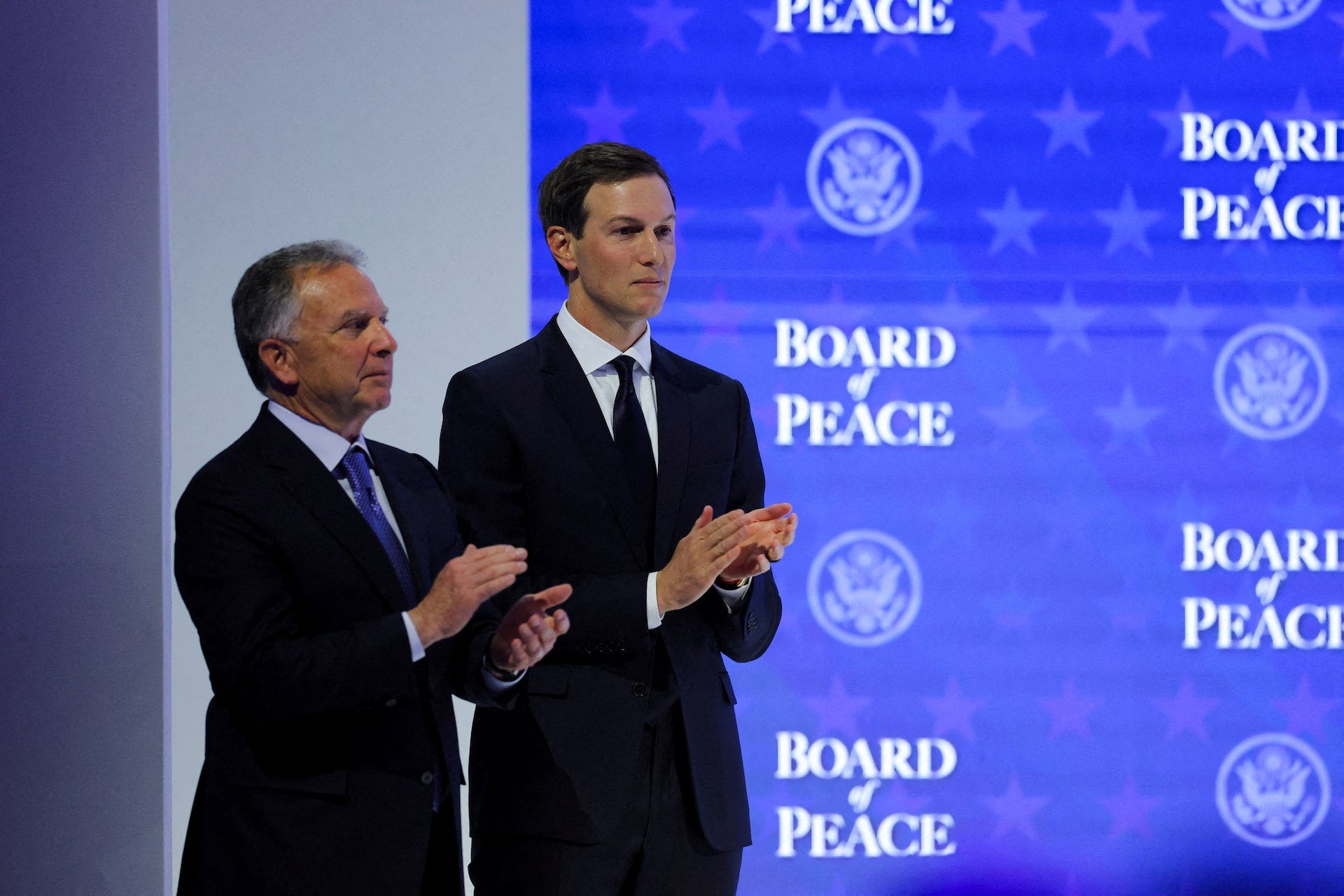
There are diplomatic undertones here as well. Soon the venerable aristocrats Steve Witkoff, Jared Kushner, and possibly Lindsay Graham (two Jews and a Shabbos-Goy?) will visit Kiev in their ongoing struggle to pacify the warring Slavic tribes. The Kyivan princelings wants ‘strong security guarantees’ from Washington, which the latter has so far been unwilling to grand.
But perhaps Kiev’s assault on Russian energy prices, despite American warnings (assuming they even existing, which is hard) is trying to ‘sell’ lower petrol prices for American consumers, in exchange for greater military commitments from the US army.
Personally, I’m skeptical of this interpretation. Ukrainian media has been consistently reporting that Zelensky is set on fighting until 2028, when he hopes the Democrats will return to Washington.
The air campaign, in order words, is probably simply part of a broader strategy to cripple Russian war-fighting capabilities. And we already know from the NYT that Trump’s CIA massively increased aid over the course of 2025 to Ukraine’s drone strike campaign on Russian energy infrastructure. The quite logical goal is to push Russia to accept American demands.
And this week has certainly been a dramatic one, whatever the causes. Robert Brovdi, head of Ukraine’s Unmanned Systems Forces, boasted of a highly productive week on April 8.
On April 5, there were attacks on Primorsk Port and the Kstovo refinery of Lukoil-Nizhegorodnefteorgsintez (phew).
On the 6th, there was a strike on the Shesharish port in Novorossiysk. A frigate with a Kalibr missile system was torpedoed. There was also a strike on Sivash drilling in the Black Sea.
On the 7th, there was another attack on the Ust-Luga terminal. The Rozsoch chemical plant in Voronezh was also struck.
All in all, no wonder many Russian military telegrams are rather unhappy.
On April 6, commenting on Ukraine’s latest strike on Russian port infrastructure at Novorossiysk, one of the largest Russian military telegrams noted that all this was possible through Elon Musk’s Starlink. Wouldn’t it be a good idea, the blogger noted, for the Russian government to raise this question with Errol Musk, who regularly visits Russia to participate in state-run roundtables with the likes of Sergei Lavrov.
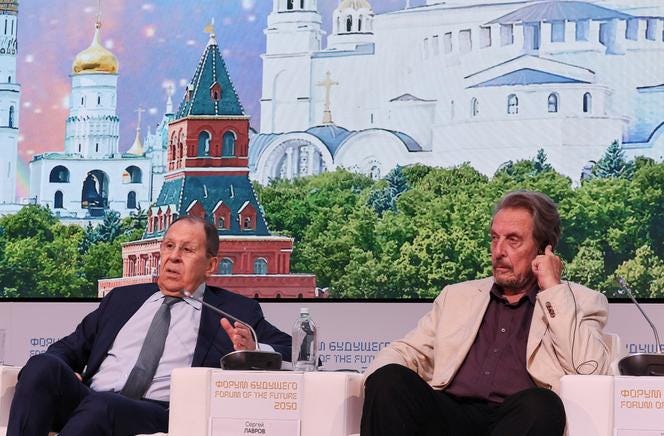
Errol Musk has even been spending the past few weeks in Russia, even managing to meet Putin. He apparently hopes to found a colony of Orthodox Christian Afrikaaners there. This will certainly help Russia win the war. Some patriotic Russian bloggers call this obsession with Musk Senior ‘an idiotic cargo cult’.
Nukes
Now, speaking of that June 2025 roundtable with Errol Musk and Sergei Lavrov’s participation.
This ‘Future 2050’ conference was hosted by Konstantin Malofeev, Russia’s so-called Orthodox oligarch. I’ve written about this rather suspicious figure multiple times in the past, but suffice to say that a man that in the 90s was a typical lackey of western finance capital has re-branded as Russia’s most patriotic oligarch.
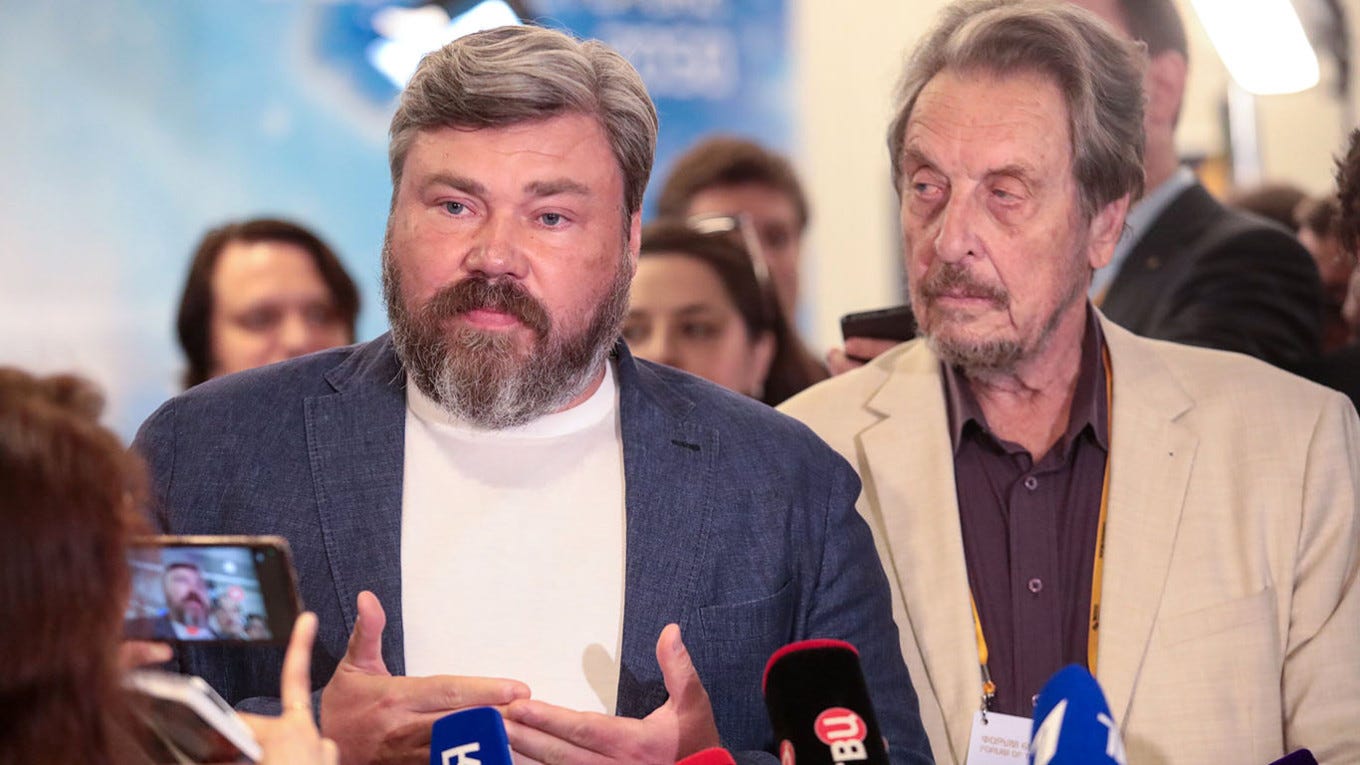
Nowadays, Malofeev’s patriotism seems to necessitate funding a large network of rightwing paramilitaries whose members often strongly sympathize with Ukraine’s Azov movement. Malofeev’s closest partners are from white-guardist families that fought with Hitler’s armies in the 1940s until decamping to the USA, where they worked closely with the CIA and its Radio Svoboda. They then returned in the 1990s to ‘continue the war my father and grandfater fought’ and privatize the Soviet economy.
Anyway, Malofeev styles himself somewhat of a grand patrician of the Russian patriotic movement, though it certainly isn’t true that he is universally beloved in that sphere. Regardless, his most recent call to action is closely linked to the advancing Ukrainian drone capacities that his fellow Russian super-patriots have been so worrying about.
Malofeev spent early April writing an article ‘we must end the war in Ukraine’. Not exactly a call for negotiations, he instead urged a nuclear strike on Ukraine to break its will to resistance. Having given a 72 hour warning to Ukrainian citizens, a ‘20-25 kiloton’ nuclear strike on western Ukraine would apparently cause ‘critical destruction and panic throughout Ukraine. The war ends within a month.’

Notably, Malofeev justifies this approach by pointing to Hiroshima and Nagasaki, but also to Trump and Israel’s current approach towards ‘bombing Iran back to the stone age’. Trump’s call last night to destroy Iranian civilization also seems in this spirit, though the latest news is that the US has apparently agreed to an Iranian ceasefire deal. Of course, with the Americans, any negotiations are often simply the cover for an even more brutal strike.
Now, this certainly isn’t the first such call. Russian political aide Sergey Karaganov has focused his career around calling for nuking European capitals to end the war in Ukraine since 2022.
However, the Ukrainian neutralist (called pro-Russian by its NATO opponents, it is in fact also critical of the Russian government) publication strana.ua saw something significant in Malofeev’s calls.
Malofeev should not be seen as somewhat with influence on the Russian government. However, he is somewhat of a bell-weather for the Russian militarist community, or the Z community, whatever you want to call it. As the rest of today’s article will see, the past few weeks have seen them immensely worried about Ukraine’s increased drone capabilities. They generally agree that Russia will still win in the long run, but as they generally put it, this will be at major cost for Russian infantrymen. To preserve Russian lives, Malofeev writes, it is necessary to bring nuclear weapons into play.
There are also political problems at stake.
Russian military telegrams like ‘Russian Engineer’ have been drawing attention to early April data from government sociologists showing a 5 percentage drop in trust of Vladimir Putin over the past week. This is the largest such drop since 2019. Analysts like Chadaev worry that the Ukrainians will take advantage of worsening Russian public opinion with their own psychological operations against the population.
Public opinion faces an important bifurcation on the matter of nuclear weapons. Strana.ua notes that polls show that most Russians prefer an end to the war on the current frontlines to continuing the war by present means until all aims are reached. However, what if they were given the option of continued war with the present means or a rapid conclusion of the war through the use of nuclear weapons?
The number of Russian troops dead from several more years of war would likely exceed the number of west Ukrainian deaths from a nuclear weapon. Strana points to official polling showing that Russian support for use of nuclear weapons against Ukraine reached its peak in 2024 during Ukraine’s invasion of the Kursk oblast — 39% for, according to the Levada centre.
Furthermore, strana notes that Washington’s increased distance from NATO further lowers the risk of nuclear retaliation for a Russian nuclear strike on Ukraine, if it ever existed. And due to the energy crisis caused by the closure of the Hormuz strait, a situation likely to remain for many months to come, if not indefinitely, Russia’s importance as a global energy supplier has increased. Given the difficult straits much of the non-western world currently finds itself when it comes to energy supply, this will make it even less likely for Russia to face serious isolation in case it deployed nuclear weapons.
Now, I find it highly doubtful that Russia will use nuclear weapons any time soon. If the US or Israel used them in Iran, that would certainly cut down some of the diplomatic costs Russia could face from its non-western allies upon nuking Ukraine, but today’s ceasefire makes it seem like the Iran war is calming down (of course, the opposite could be true). The Russian government, in any case, is committed to its policy of insulating most of the population from the war, hence the lack of general mobilization.
If, however, Ukraine continues advancing in its drone capabilities, this could lead not only to the failure of Russian assaults, but even to broader and more successful Ukrainian counterattacks, like those of January and February 2026. In that case, a new Russian mobilization is highly likely, like that which occurred in late 2022 following successful Ukrainian counter-offensives. And only if that still doesn’t work, would it be likely for nuclear weapons to be deployed.
The risk isn’t non-existent. According to the American press, Russian forces were allowed to retreat unscathed from Kherson in late 2022 because of this threat. Then, Russian command communicated to the Americans they would use nuclear weapons in response to a Ukrainian attack on the thousands of retreating Russian troops.
Apart from possible Ukrainian frontline successes, there is also the threat of increasing long-range strike capacities. A few days ago, Denis Shtilerman, the co-owner of Fire Point, Ukraine’s most famous (and infamously corrupt) drone company stated in an interview that his company’s missiles will soon be able to reach Moscow. He said that the current ‘Flamingo’ missiles only have a range of 350 kilometers (half the originally stated range, by the way), but that new missiles developed in mid-2026 will have a range of 850km.
The following section from the interview was particularly amusing:
Ukraine is fighting with its hands tied. For every HIMARS launch, we receive some kind of authorization codes from the Americans. For every little move, we have to get permission.
So how are all of Ukraine’s constant strikes against Russian infrastructure even possible? Obviously, NATO is completely involved. The NYT itself, hardly one to praise the Trump administration, wrote in late December 2025 that the CIA, with Trump’s approval, has massively increased intelligence aid and coordination of Ukrainian strikes on Russian energy infrastructure over the past year.
There are likely also ulterior motives in this nuking narratives. Malofeev was once one of the greatest supporters of Evgeny Prigozhin, who moved from massive criticism of the army to launching a mutiny, even a coup, marching on Moscow during the height of Ukraine’s 2023 counter-offensive. The Russian militarist bloggers who are complaining about a drone crisis at the front were also once partisans of Mr Prigozhin.
In other words, these patriotic figures have their own political ambitions. Malofeev loves pointing to Trump’s supposedly superior approach towards Iran, and Malofeev himself has a number of business and political ties with figures from Fox News, and US finance capital more broadly.
Given that Malofeev’s anti-satanic, anti-communist, anti-pension, anti-migrant, pro-monarchist agenda is rather reminiscent of Trump’s, it’s often hard to take Malofeev’s loudly voiced criticisms of the Orange Demon seriously. Perhaps the CIA wants Russia to deploy nukes against Ukraine, given that it would further isolate it from the world (though, as we said before, this isn’t certain). Perhaps Trump wants Putin to break the nuclear taboo, so that he can follow suit against Iran.
Let’s now take off our tin-foil hat, and look at more banal affairs. For instance, the aforementioned fact that Putin’s popularity is apparently falling. This is not directly due to frontline affairs, but rather from the stagnant economic situation and unclear future horizons. Ukrainian drone strikes on Russian civilian infrastructure don’t help.
Obviously, general mobilization would be quite politically dangerous in this situation. Malofeev and co, in turn, could claim that if the Russian leadership had simply nuked Kiev, all these problems would have been ended long ago. Quite a cunning political strategy for rebellious insurgent forces.
Strana has a more prosaic interpretation. It believes that Malofeev’s article, along with the drum-beating these recent weeks among Russian Z-telegrams about Ukrainian drone superiority, has the aim of convincing the Russian government to use nuclear weapons against Ukraine. If Ukraine succeeds in striking the Kremlin or yet more sensitive energy assets, strana worries, the existence of the Ukrainian people could be in danger.
Ukraine winning?
Now let’s take a look at all these claims that Ukraine is winning the drone war. Our Russian correspondents, which include some of the country’s most famous drone manufacturers, have been quite furiously productive in publishing graphs, data, and personal experience on this matter. We’ll examine what they have to say about:
— Ukrainian organization of drone warfare
— Increased Ukrainian strikes on mid-range Russian military logistics, particularly air defense systems
— Russian vs Ukrainian drone production capacities
— Claims that for the first time, March saw more Ukrainian drone strikes on Russia than vice versa
Throughout, we’ll also see an emerging consensus on both sides — focusing on mid-range military logistics is more effective than hoping to cripple energy infrastructure through long-range strikes.
