July war deepdive
Northern retreats, southern confusion, Donbass developments.

With all the intrigue over the minister of defense and commander in chief this July, it’s been hard to pay attention to the frontlines. But things there have been the same as usual — slow Russian advances. Though Zelensky’s financial motivations are likely to blame for his personnel musical chairs, perhaps the fact that the frontline is going as badly as usual had at least something to do with his decision to get rid of Mikhailo Fedorov as defense minister. After all, despite all of Fedorov’s excellently communicated claims of destroying Russian logistics and striking all forms of targets in Russia, none of this has changed the actual direction of the war.
I gathered together the most detailed daily analysis of the battlefield from several Ukrainian military analysts, one of whom is an active soldier. Here’s a brief summary of July events.
The main target for Russian forces are the remaining cities of the Donetsk oblast, the Kramatorsk and Sloviansk agglomeration. To the south, they are consolidating their control of Kostiantynivka and moving north into Druzhkivka and nearby towns, which is essentially the southern outskirts of Kramatorsk/Sloviansk. Because fighting through that urban territory is quite a slog, they are also trying to push forward to the western flanks of Kramatorsk, into Dobropillia. To the west of Kramatorsk/Sloviansk, constant airstrikes are transforming towns like Malynivka into a flat wasteland, making it very difficult for the Ukrainians to maintain any positions there. Battles for Lyman also continue to the north of Sloviansk, though the fiercest struggle is for the western, southern and western flanks. Drone strikes on Kramatorsk/Sloviansk itself are increasing in frequency as Russian troops approach the city, along with all routes leading in and out of it.
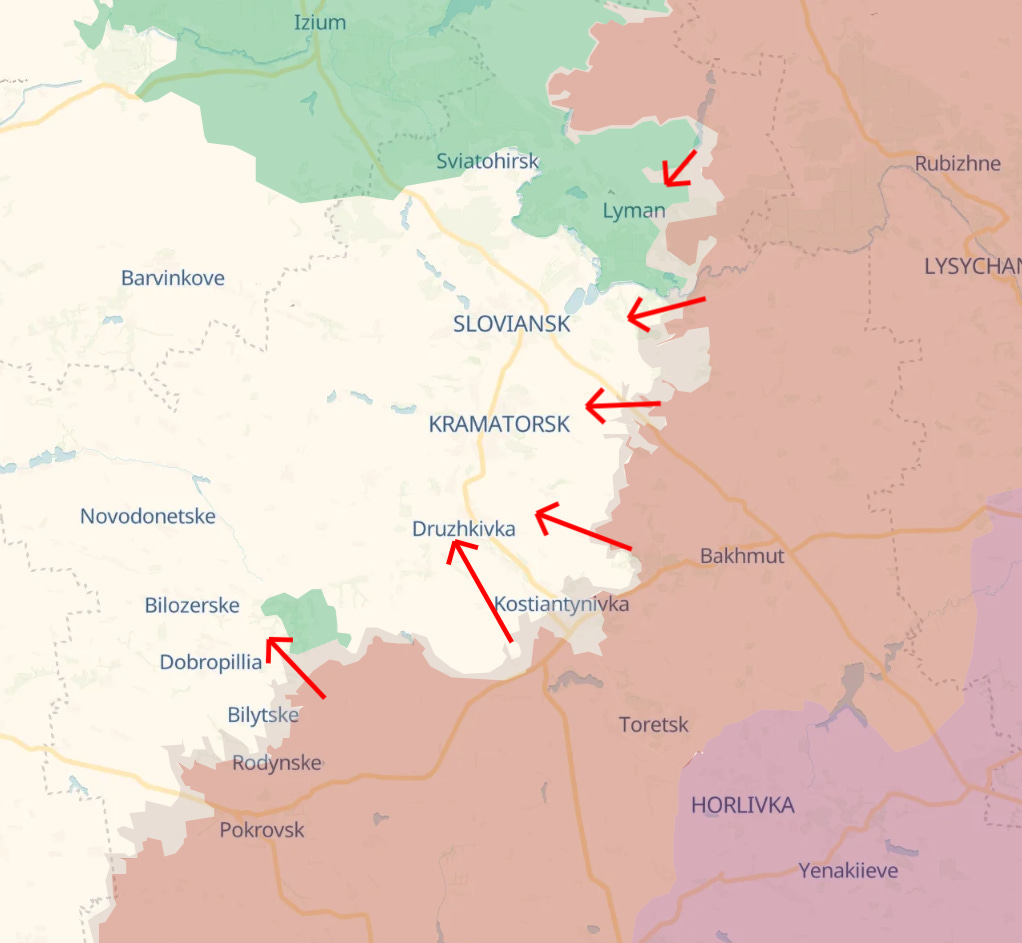
The situation has also markedly worsened in the Kharkiv oblast, to the north of the Donetsk oblast. In the border areas with Russia, Ukrainian troops have had to make some retreats this July. Around Kupyansk, retaken by the Ukrainians in late 2025, the Russians have put large swatches of territory in danger, and pushed Ukrainian troops out of much of the city as well. Ukrainian military experts complain about the scarcity of defending infantry in the area. The situation here carries serious risks for the massive city of Kharkiv and logistics to the Donetsk oblast as well.
Down south, endless battles continue for the agricultural steppe of the Zaporizhzhia and Dnepropetrovsk oblasts. Ukraine relocated a number of assault units to the area throughout late 2025 and 2026, desperate to stop Russia’s significant advances in this under-defended area in 2025. Ukraine largely succeeded in slowing the advances, and decided to mount a number of counterattacks, hoping to gain western support through territorial successes. There have been some territorial successes, but rather small ones, highly exaggerated by the government and army. And they have come at great cost in men and equipment. Russian command, meanwhile, is content to let the Ukrainians throw themselves at this territory, which it does not consider particularly important at the moment. The villages changing hands had peak pre-war populations of 8.
Otherwise, the trends are the same as the rest of 2026. Russia continues fielding new specialized drone units from its Unmanned Systems Forces, whose expansion is a priority for the Russian army (and its Ukrainian counterpart). Russia continues hammering Ukrainian positions with massive airborne glide bombs, a capability Ukraine sorely lacks despite attempts to come up with domestic analogues. Ukrainian troops continue to be ordered to hold positions no matter what, leading to losses and encirclements. Local commanders keep on lying to higher-ups about how much territory they control for fear of reprimands, leading to collapsing flanks and inappropriate troops relocations. No matter what drone-fetishists say, it remains impossible to consolidate and hold territory without infantry, a deficit commodity for Ukraine. The real state of affairs on the ground also seems to be increasingly unrecognizable from what is shown on DeepState, Ukraine’s most-often consulted mapping service (and the one I’ll use to illustrate today).
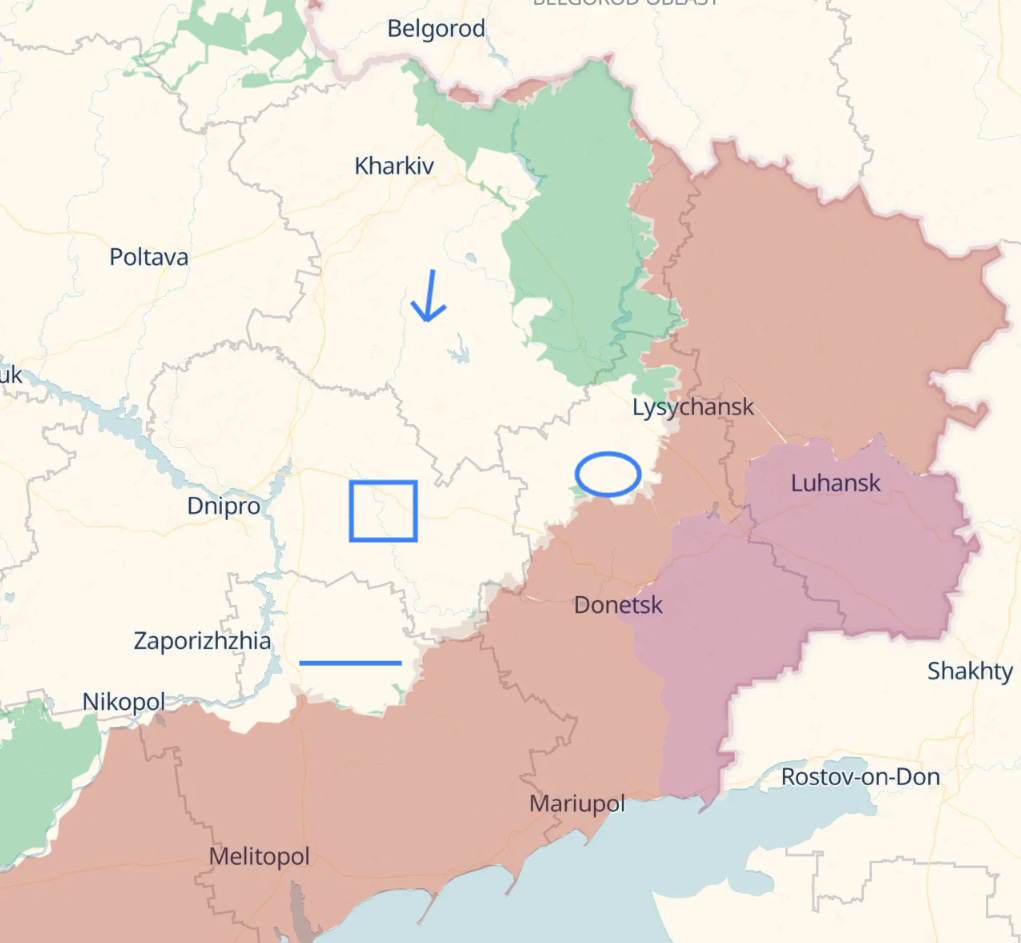
Let’s now get into 10,000 words about the July battlefield. We’ll be covering the Kharkiv oblast (arrow), Donetsk oblast (circle), Dnepropetrovsk oblast (square), and Zaporizhzhia oblast (line). Every day, from June 30 to July 27. Instead of organizing it all by region, I’ve kept it chronological. After all, it’s all connected.
Stream of battle
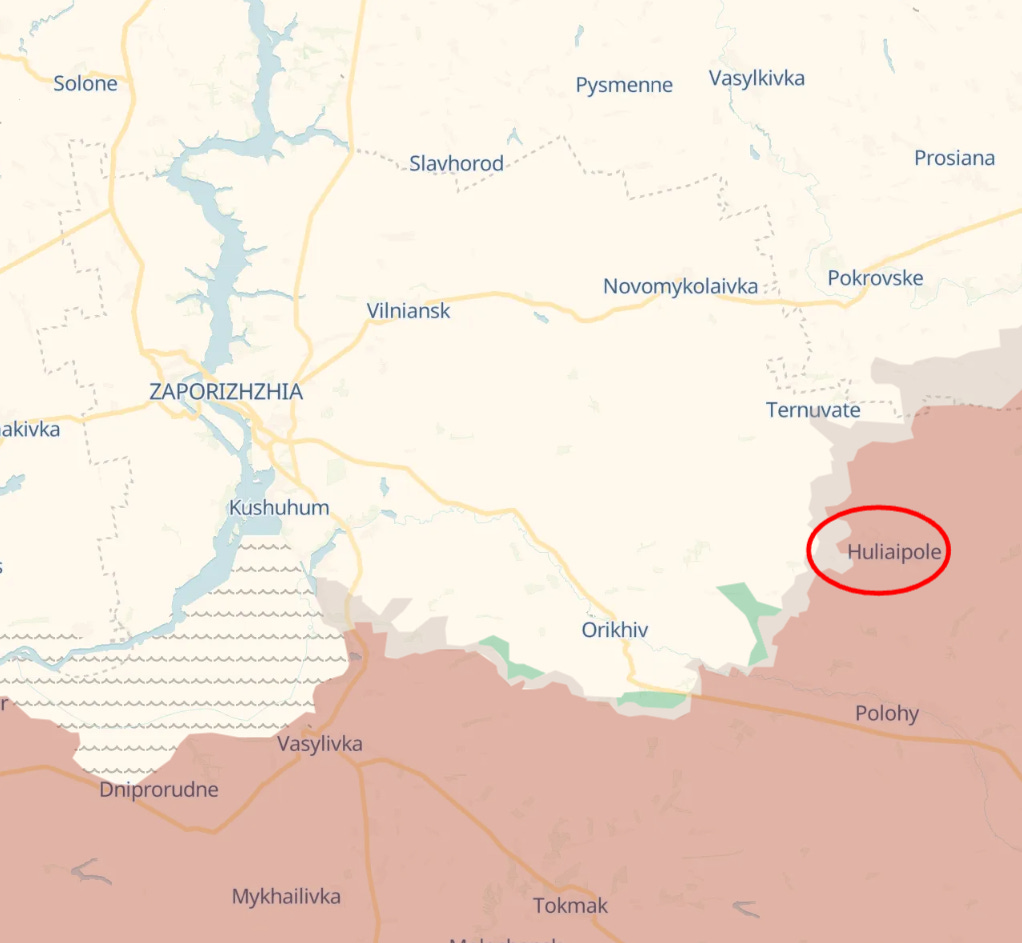
On June 29, the Ukrainian serviceman ‘Muchnoy Jugend88’ complained about Ukrainian ‘flag operations’ to claim control of the town of Huliaipole in the Zaporizhzhia oblast, when in fact ‘it is actually under full fire and physical control of the enemy’. This means that Ukrainain troops are sent on missions to hold up Ukrainian flags for the camera as though the settlement is controlled, even though they will probably be killed, captured, or forced to flee by Russian airpower.
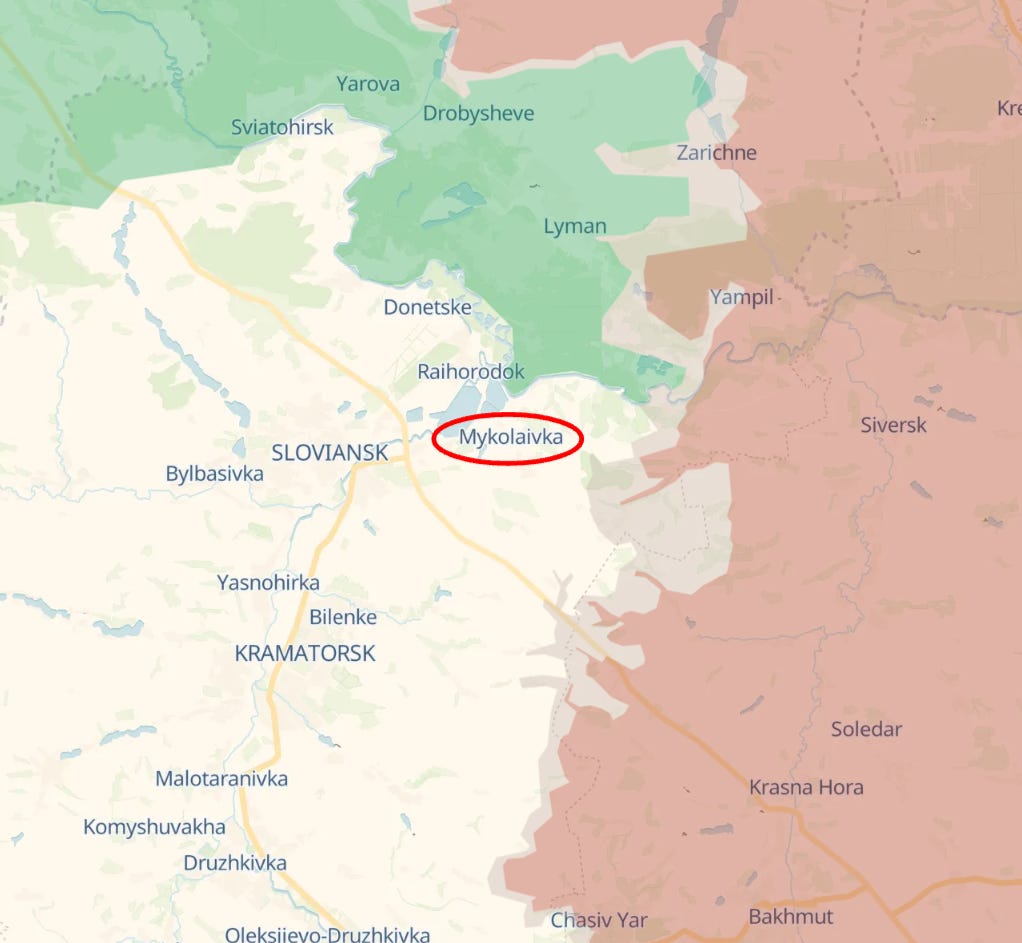
The same day, he wrote of the continued ‘systematic destruction of all infrastructure’ in the Donetsk oblast town of Mykolaivka, mainly by glide bombs. Once the Russians entirely ruin defenders and gain full control of the town, he writes, their next destination will be Sloviansk itself. Muchnoy believes that unless there are ‘cardinal transformations’, fighting will indeed eventually begin for Slvoiansk.
On June 30, Muchnoy reported on the activity of the Russian Unmanned forces battalion ‘Oryel’ (Eagle).
