Infowars
Our liberal democratic future in Ukraine. Corbyn, Pomerantsev, fact-checkers.

If you’re reading this substack, you probably like information. I must too, if I’ve been putting out four articles a week for the past two years about events in a land which, at least geographically, is now very far away.
Sometimes I think about the purpose of processing all this information. In the past, I probably had more ideals about it. Perhaps getting information out could result in something.
At this point, it’s hard to believe. It smells all too much like the idea that ‘democracy can be saved’ if only all citizens had access to enough — or ‘correct’ — information. If anything, that sounds like an excellent slogan to keep people buying smartphones.
It’s easy to get addicted to information. I remember in the first week of the war sitting in Kievan bomb shelters and scrolling telegram until 3am each day, just like everyone else. You kid yourself that this would somehow ‘keep you safer’, when actually it infects you with a collective psychosis egged on by politicians and professional infowarriors. Leaving Ukraine and spending a few weeks or months off telegram was quite blissful. Most of the Ukrainian or Russian people I know who left haven’t checked the news for years.
But anyway, 4 years later, here we are reading about events in Ukraine. Though my convictions haven’t changed, I’ve felt for quite some time that events are entirely out of our control. Perhaps at some point, before 2022, it would have been possible to avoid all this. Perhaps not. At this point, however, there’s too much blood, money, and politics already invested in the war to simply end it. Maybe it’ll end in six months, or a year, or two, with Russia in control of all the Donbass. Maybe it won’t end there.
I’m quite happy to admit that I simply enjoy understanding what is happening in this strange world. There might be some other motivations — maybe the British government is at least somewhat serious about the likelihood of the war becoming pan-European by 2030, if not global.
Today’s large-scale Ukrainian drone strike on Russia seems to be an excellent step along that path.
Pro-Ukrainian commentators are gloating that Russia’s strikes on Ukrainian energy refineries have little effect on military industry, since Ukraine’s weapons are increasingly made in Europe. Russian officials and military analysts have been increasingly cognizant of that fact, too.
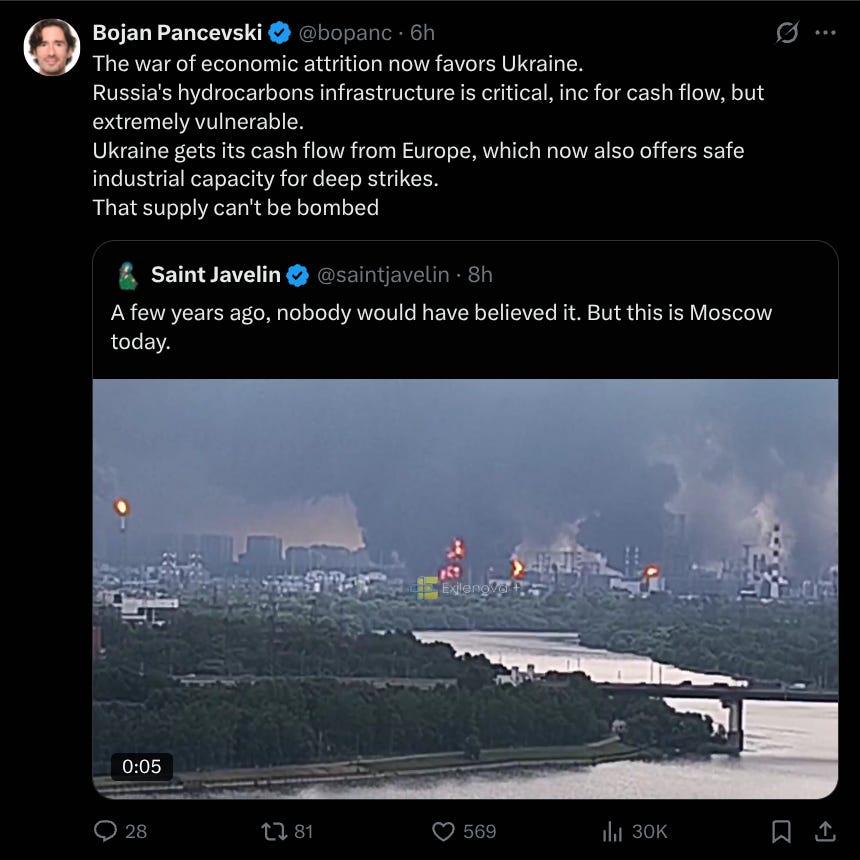

The Ukrainians place much more stock in information than I do. Today’s strike on Russia, needless to say, won’t affect the military situation on the frontlines. It is quite likely to affect Russian minds, however, although how exactly is less clear.
What is more predictable is the reaction it will engender westward. Ukraine’s military strategy has always seemed aimed at securing continued western funding, hence largely focused around the ability to engage western audiences.
This information obsession has sometimes been harmful, like when constant advertisement of their imminent intentions led, at least partly, to the spectacular failure of the 2023 counter-offensive. Or the late 2024 invasion of the Kursk oblast, whose only tangible aim was to raise domestic morale and convince western audiences that the country was not out of the fight. Ukraine’s drone campaigns have until recently focused mainly on enemy infantry, moreso because snuff films are more titillating than destroying strategically important targets, such as enemy radar systems or supply vehicles.
A particularly interesting example of this infofixation came this week. Mikhailo Fedorov, the Palantir-favored minister of defense, announced his much-awaited grand reform of military salaries and service rules.
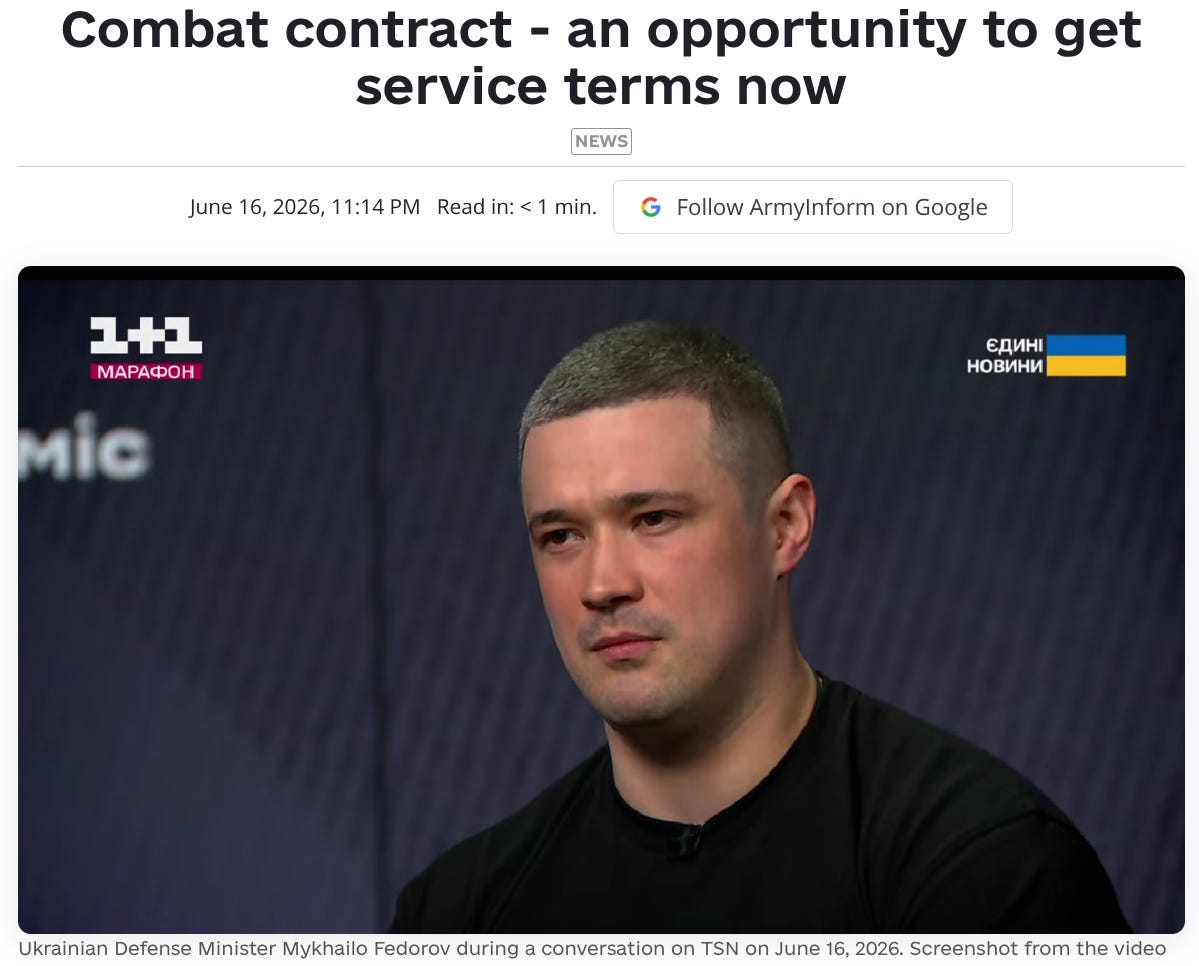
Throughout the war, there have been constant complaints by servicemen about the lack of fixed terms of service, meaning that troops have to fight until death or severe injury. Upon injury, they either become financially dependent on family members, or they serve in a rear unit and receive the minimum military salary — 20,000 hryvnia, or around $500 USD. Hundreds of thousands of troops receive this minimal salary, one lower than security guards at supermarkets.
Fedorov decided to tackle this problem rather interestingly. The western press, as usual, has been effusive about this ‘young reformer’s’ latest genius solution. Ukrainian soldiers interviewed by the (western-funded) liberal nationalist press, meanwhile, have been outraged by it.
Fedorov’s reform (he calls it a ‘transformation’) has two components. In terms of salaries, the minimum military wage was increased to 30,000 hryvnia. This still remains far too low, particularly amidst the massive inflation of the past year.
Most importantly, new contracts were introduced, which are supposedly ‘fixed-term’. In fact, they are just as indefinite as before, except broken up. Upon the ‘end’ of the 24-month contract, the lucky soldier receives a 6 month rest period during which they are exempt from mobilization. After that, they must either sign a new contract or be shoved into a mobilization minivan.
So essentially, these are the same old contracts, but with unpaid rest periods. How one is to make money in such a period is a problem that concerns many.
The most interesting aspect of the contract is why I brought it up in today’s article on information — Fedorov’s new contracts have massively increased salaries for those serving in infantry assault units. Such troops, if they join through Fedorov’s special assault unit contract, will now receive 300,000-460,000 hryvnia a month — around $10,000 USD. These are immense sums of money. Fedorov boasts that these are the highest infantry wages in the world.
The special assault unit contract also involves a much larger rest period than the other two new contracts — each month spent at the front results in three months of rest time. The catch is that the lifespan of an assault trooper is notoriously low — often just a few weeks.
There are of course legitimate reasons to attract more infantry. Despite Fedorov’s well-known drone fetishism, there’s no way to hold territory, let alone advance, without living soldiers to hold it on the ground. Ukraine’s lack of manpower has long been one of its main issues. However, the fact that the new contracts promise much lower salaries to drone operators than to the much-criticized assault units has already resulted in a great deal of discontent among military figures.
But there are also quite significant informational elements to this. The assault units were originally born in the 2024 Kursk operation. They were also the key units involved in the early 2026 ‘counter-offensive’ in the southern sections of the front. In both cases, initial gains were eventually lost back to the Russians. The latter are once again advancing on Ukraine’s southern front.
But the original advances were certainly delectable for media consumers, particularly western ones. It later came out that the assault units in Kursk suffered 90% losses, and those conducting endless counter-attacks in the south are still condemned by other Ukrainian militarists as ‘suicidal idiots’. No one needs to know about that.
One question I often have is who exactly these info-operations are aimed at. In Ukraine, there isn’t really much need to convince people into believing. Millions don’t believe, and hence sit at home avoiding mobilization. The state mobilizes people by throwing them into a bus and beating them into submission. The majority claims to believe — or maybe even does believe — because they know the alternative is being attacked by state-employed brown shirt goons or thrown into jail as a ‘collaborator’.
Western audiences? In any country, the majority will answer polls the way the mass media tells them to. I don’t think the majority really cares all that much how many kilometers of gray zone were supposedly recovered in the Dnepropetrovsk oblast.
When it comes to high-effort information warfare, particularly of the western liberal variety, it seems to me there is only one real target — the middle-class knowledge class. Journalists, academics, NGOs, programmers, and all the rest. These are meant to be the mass base of support for western-style liberal democracies. This same class is also the main target of psychological operations abroad, both in enemy countries (Russia, Iran) and in ‘allies’ threatening to break loose (Hungary, Romania).
These are the people eagerly reading the latest articles about how Ukraine has changed the tides of war. Historically, however, they haven’t always been loyal to the liberal project. Communism, fascism, and other forms of nationalism have always been driven largely by the petit-bourgeois, the ‘vacillating class’ as Lenin called them.
Luckily, experts do exist to manage this unruly herd. Let’s continue our exploration of their intellectual leader. As usual, his ruminations on the dastardly eastern foe has much more to say about the future of the west than anything else. Today’s analysis of London’s greatest psywarrior will take us a great deal of places, simply by looking at some of his most admired heroes: from Facebook-employed neo-nazi fact-checkers in Ukraine, to Russian millionaire ravers in London, to the anti-Corbyn ‘anti-semitism’ campaign.
Defeating the omnipotent enemy
Peter Pomerantsev is at the avant-garde of western info-war. Unlike his older friends like Anne Applebaum, Timothy Snyder or Bill Browder, he isn’t content to simply proclaim western civilizational superiority and take it from there.
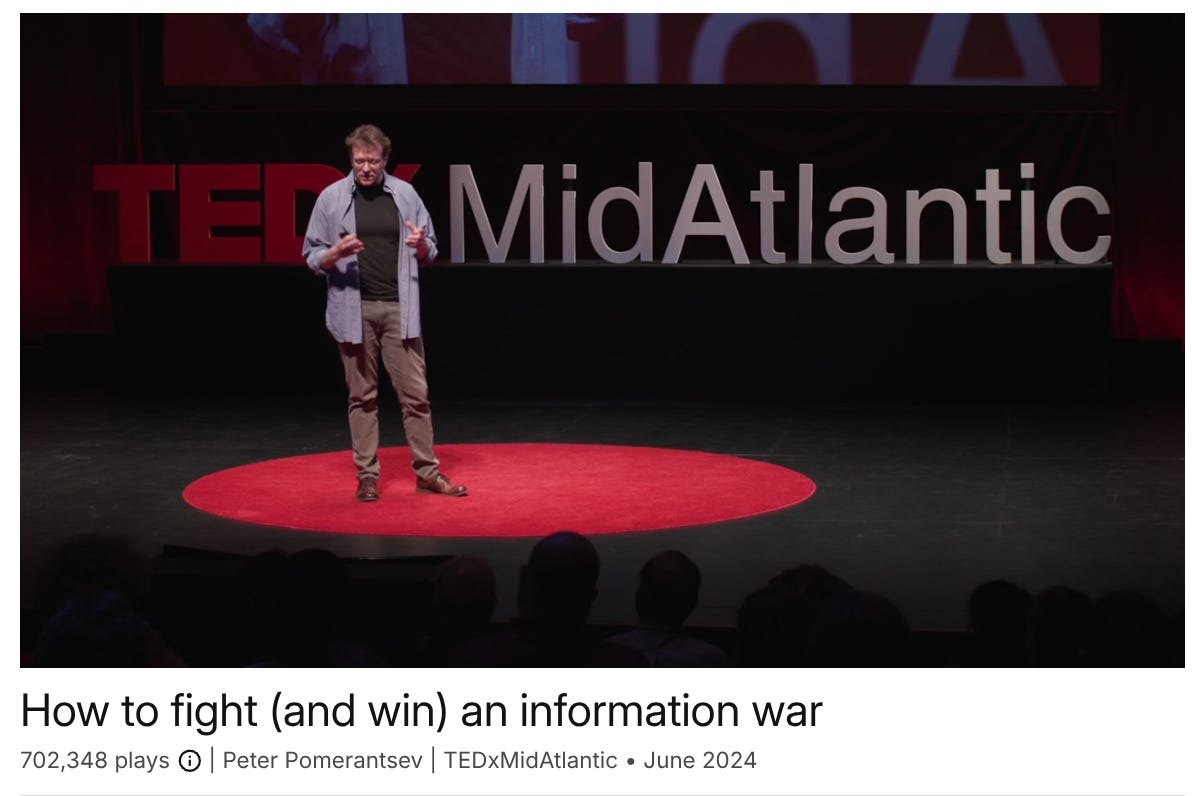
Pomerantsev is part of a younger generation of left-liberals, close with the likes of Michael Weiss, Ben Judah, or Arash Azizi. In terms of formulating something like a philosophy of information warfare, even a new philosophy of the liberal subject, he is likely the most sophisticated.
Unlike the old guard, his prose is cynical, resigned. Which is precisely the point, given his conviction that the great subverter of western liberal democracy, Russia, operates not through ideological models, but through ‘cynicism and agnosticism’.
Of course, some things never change. Just like when the CIA justified the need for MK-ULTRA human experiments on the basis that the Chicoms were doing it, so too does Pomerantsev’s project of psywar rely largely on constructing the idea of terribly powerful Russian psy-wizards.
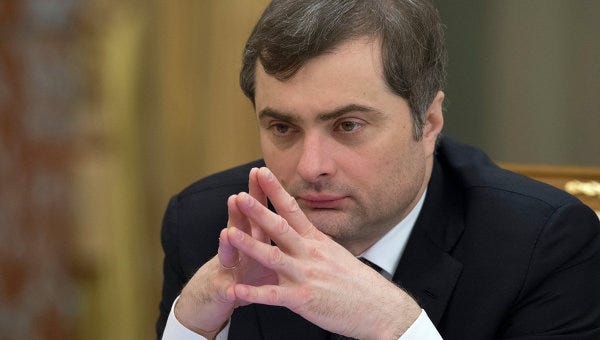
His popular 2014 book Nothing is True and Everything is Possible features Russian presidential official Vladislav Surkov as the great villain. Surkov was said to embody the new ‘postmodern dictatorship’, which apparently works through encouraging general cynicism and manipulating a range of controlled oppositions. The idealist west is powerless before this new psy-poison.
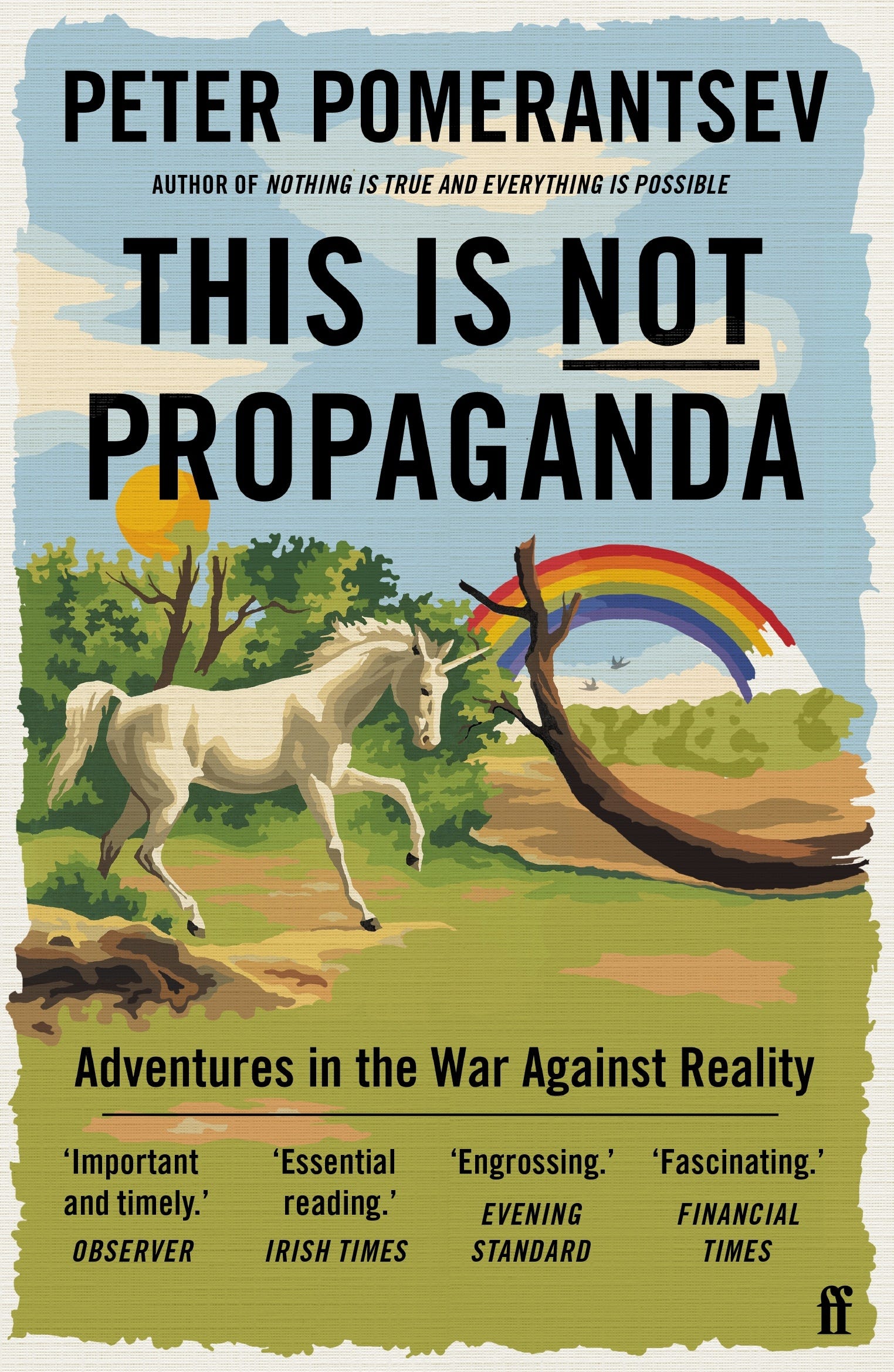
In his 2019 book This is Not Propaganda, Surkov is absent, despite Russia still being ever-present. The subtitle, ‘Adventures in the War Against Reality’, links quite well to his previous book, which argues that Russia is aggressively targeting postmodern simulations at the west, where ‘words really mean something’.
At the end of Nothing is Real, Pomerantsev worried that Surkovian info-war means the cold war may not have been won by the west. But in the meantime, the real Surkov experienced a number of failures.
