Are the past three months characterized by Russian regrouping following the successes of 2025, or bloodily failed Russian assaults?
Is it possible to speak of successful Ukrainian counter-attacks in the southern section of the frontline (Zaporizhzhie and Dnepropetrovsk oblasts)? After all, venerable Russia-watchers like Bill Browder and ‘clean energy investor’ Ramez Naam are sure that these counter-attacks have just about won the war.
To the first question, probably both. As the weather improves, Russian assaults have been increasing after the winter lull. However, Ukrainian adaptations to the Russian infantry infiltration tactics developed over the course of 2025 mean that many of these assaults fail. Nevertheless, Russian drone and general air domination, combined with greater infantry resources, mean that 2026 will see more Russian advances. However, the maximum possible this year would be Russia taking the last cities of the Donbass, and getting within reliable artillery range of the major southern cities of Zaporizhzhie and possible Dnepropetrovsk. The independent factors will be the supply of western aid to Ukraine and Ukrainian manpower reserves.
As for the second question, yes, as long as one qualifies success. If, as most reasonable Ukrainian military analysts do, the aim was to slow down the (still ongoing) Russian offensive in the south, then yes, Ukrainian counterattacks achieved that goal. The size of the advances is several times smaller than Zelensky’s claims, but the Ukrainians have increased their presence in some contested areas, and pushed the area of contestation into some territories previously consolidated by the Russians. But all this has not been without losses for the advancing forces. And what exactly is the point of this ‘1-2 month delay’, in the long run?
Not that the long run is a question that’s ever worried anyone that much.
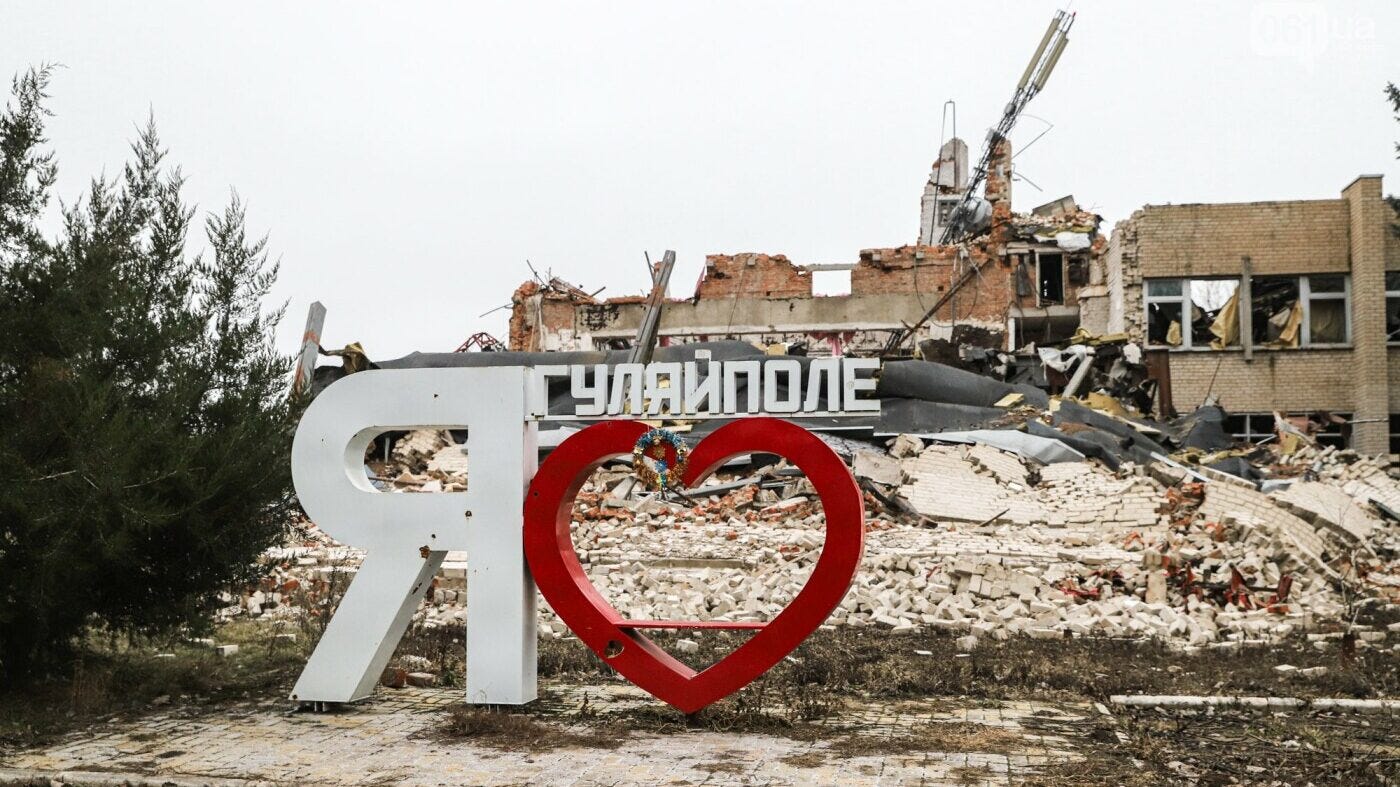
‘I love Huliaipole’ — one of the key towns to be discussed today.
Stalemate?
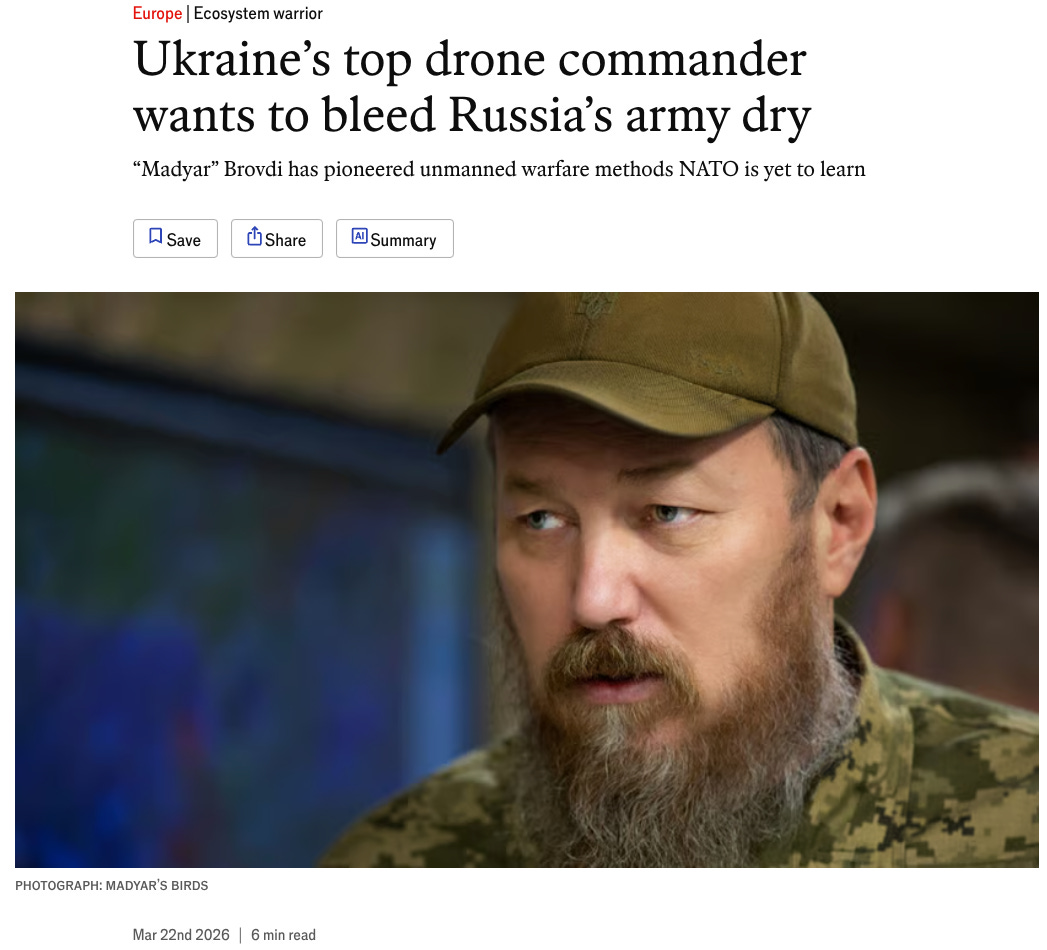
The western press put out an interview on March 22 with Robert Brovdi, commander of Ukraine’s unmanned systems forces (SBS). As usual, he boasts that his SBS is killing more Russians than ever, destroying more manpower than is recruited. Though I find it hard to take him seriously, Russian military telegrams tend to enjoy puffing up his image. In any case, one can at minimum state that the Russian army would do well to find better ways to overcome Ukrainian drone operators.
Russian military bloggers — from the ‘patriotic opposition’ that once supported Evgeny Prigozhin — give a very pessimistic picture, as always. As usual, one can make all sorts of hypotheses explaining this. Perhaps they are CIA agents trying to destabilize Russia, just as Russian senators now say Prigozhin was. Perhaps they are angry that the blocking of telegram will destroy their income. Maybe they are attacking the regular army as part of a psyop to encourage the renewed growth of Wagner-like private military organizations, or as part of some other elite conflict within the ‘towers of the Kremlin’.
Or perhaps — or rather, definitely — they are simply engaging in the old east Slavic tradition of soul-deadening pessimism.
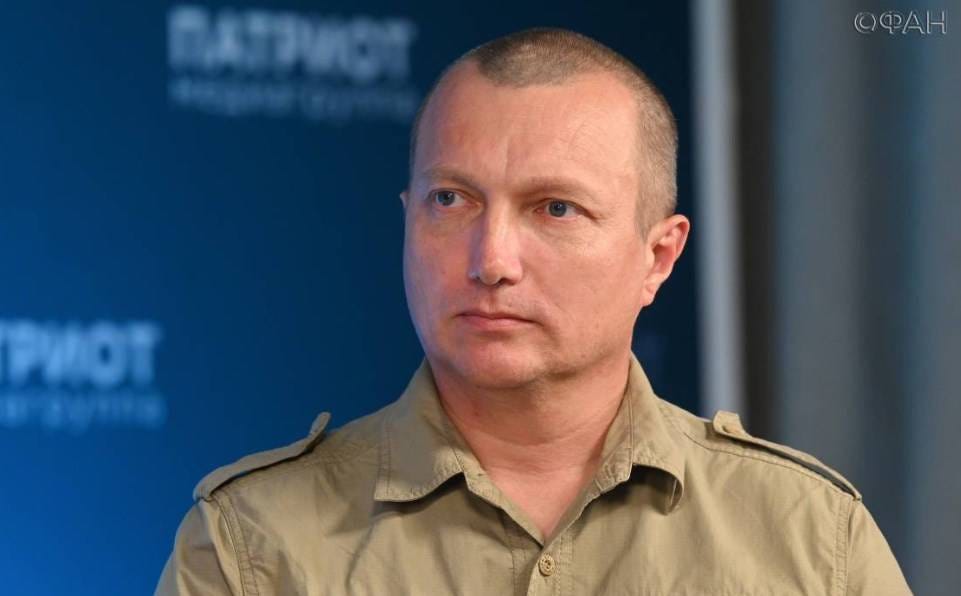
I will say that journalists like Aleksandr Kharchenko and Aleksey Sukonkin are quite measured, respected analysts. Let’s take a look at what they’re saying about the bloody semi-stalemate at the front.
Aleksandr Kharchenko, military correspondent for RIA Novosti, wrote about how the Ukrainians have adapted to Russian infiltration tactics on March 24:
Kharchenko
On the realities of the front
Drones have definitively taken over the battlefield. In 2024, you could slip through on a motorcycle; in 2025, you could run along a tree line; now only the lucky ones reach their objective. Aerial surveillance is total. Movement between positions happens only in bad weather. Evacuation from the front line has practically stopped.
No, this isn’t another critical piece—these are reflections. The enemy’s situation isn’t any better. Our offensives are halted not by infantry, but by a line of drones. The front has become nearly deserted. “Mavic” recon drones far more often record the flight of a “Baba Yaga” bomber drone than the movements of enemy soldiers. Reaching cover and staying there for months has become a viable survival strategy.
Of course, we need a breakthrough on the front—but how can it be achieved? Even if we find another 400,000 volunteers, it won’t change the situation. You can send not one but three people into an assault, but that will only increase losses without producing a turning point.
The mechanized armies of the 20th century have lost their relevance, and the infantryman has reached the limits of human capability. As banal as it sounds, the smarter side will win.
If in 2022 the front had been held by this many enemy infantry, the Russian army would have reached Dnipropetrovsk in two days. Results like that will only be possible when “reusable armored vehicles” appear on the battlefield. For now, no armored unit can survive multiple drone strikes.
If every armored vehicle could shoot down a dozen drones, offensive operations would become viable again. Unfortunately, such machines are unlikely to appear in large numbers this year.
For now, the rule on the battlefield works flawlessly: whoever has drones that fly more accurately and more often has the advantage. But this applies only to the current stage of military technology. A breakthrough lies ahead.
If you asked me what should be done now, I would minimize attacks and infiltration attempts and direct all resources toward developing mass-produced active protection systems against drones. Infantry needs a new technological leap and new armored vehicles. Without these, we risk wasting lives without meaningful changes on the map.
—Alexander Kharchenko
Military correspondent and novelist Alexey Sukonkin replied to the above on March 24:
Sukonkin
Unfortunately, from my vantage point I see no changes in the approaches to planning and conducting offensive operations. Short-lived rank-and-file soldiers are still being burned through by long-serving commanders, as if they were a resource that can be quickly replenished, and as if the country has an endless supply of money to pay out death benefits. With the current approach, mobilization will not save the situation—it will only make it worse and ultimately lead to the country’s collapse, which is exactly what the enemy wants. What’s needed at the front are different kinds of decisions—not tactical or operational, but strategic ones. As is well known, no amount of tactics can compensate for a failure in strategy.
To understand these words, look at how the Persians solved the problem.
Then there will be no need to kill so many of one’s own soldiers against the soulless war machine called the “drone line.” The time of “large battalions” is gone for good. It’s a pity that those for whom war is nothing more than arrows on maps and sugary reports from obsequious subordinates refuse to understand this.
I have seen many different commanders—from thoughtful, educated strategists to dull, self-absorbed butchers—but to this day I consider the best to be two who, more than others, knew how to value available resources, plan their actions in meticulous detail, motivate their subordinates for success, and instantly assess advanced technologies, implementing them within their units. I believe the basis of their success was that they treated war as an economic project that must generate a margin, not a loss (though not in the sense understood by commanders who exploit their subordinates), otherwise “why be at all.” One of them was a businessman; the other had experience in three fields at once—military, entrepreneurial, and administrative—which set them apart from ordinary military managers and allowed them to deliver results no one else could.
Unfortunately, they were killed in 2023 and 2025 under highly ambiguous circumstances.
Incidentally, the enemy’s most effective commander is also not a career military man. But, to our regret, he is still alive and doing his job very effectively.
How can one not recall Charles-Maurice de Talleyrand-Périgord: “War is too serious a matter to be entrusted to military men.”
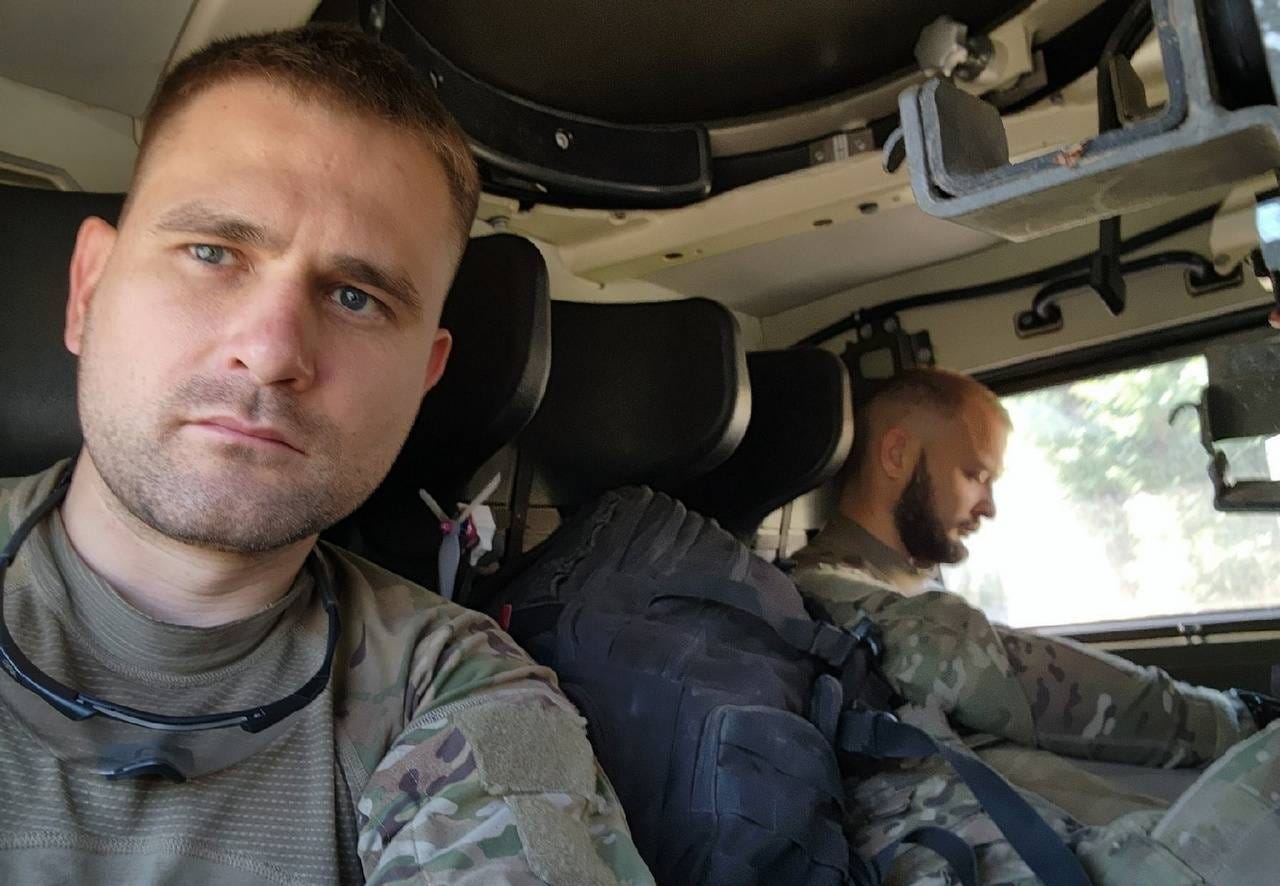
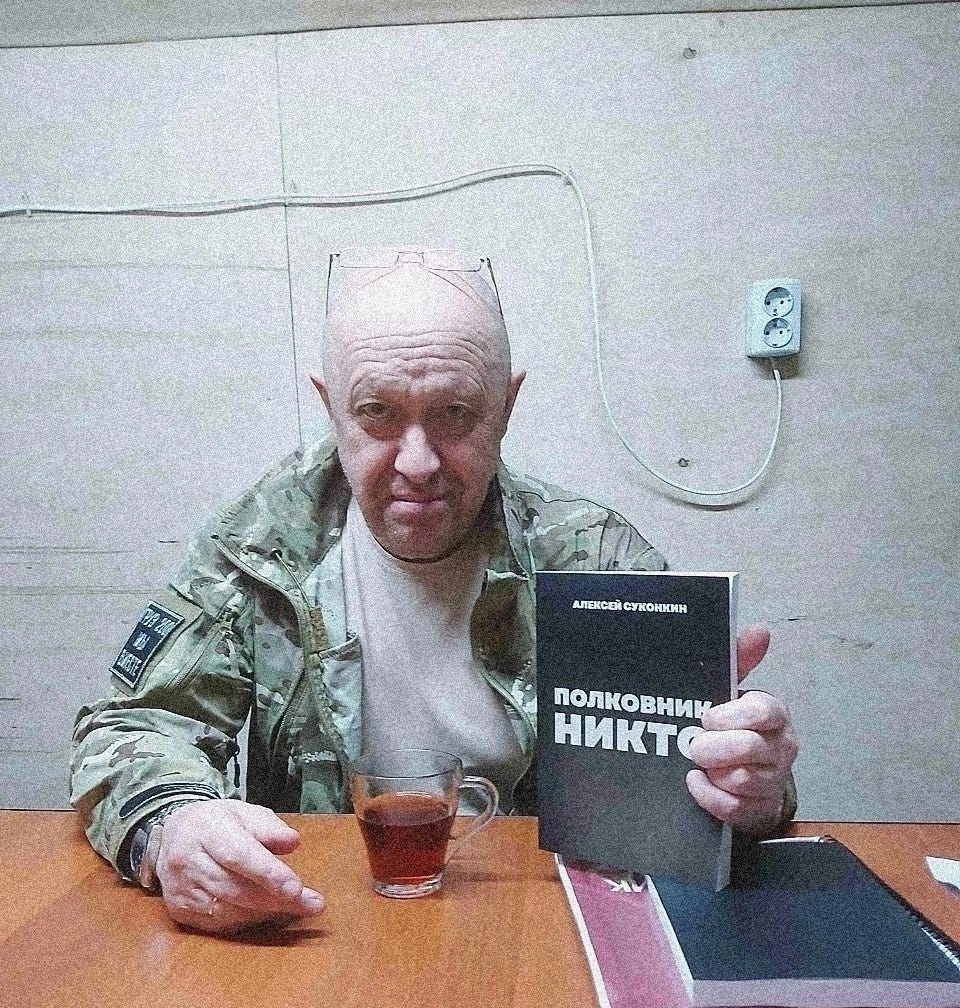
An unforgettable individual holding a copy of Sukonkin’s novel ‘Colonel Nobody’, a much-loved book about the 2022 phase of the war I hope to review soon.
That sentence about ‘the enemy’s most effective commander’ refers to Robert Brovdi, who was a businessman until 2022. He was also involved in some rather notorious corruption scandals, but everyone seems to forget about that nowadays.
Besides approaches to deal with enemy drones, a common point of complaint is insufficient care paid to training troops. This is true on both sides, and given the negative demographic trends both countries experience, probably not the best idea.
The popular news channel Hedgehog posted this on March 23. It was reposted by the patriotic writer and senator Zakhar Prilepin and a number of other military bloggers.
In the “special military operation,” former head of the youth wing of the Rodina [a patriotic organization - EIU] party, Vladimir Laktyushin, has been killed—just 10 days after signing his contract. The death of the politician, who in 2015 created the “Tigers of Rodina” movement, was reported by war correspondent Alexey Zhivov:
“He went to serve and died just 10 days after signing the contract. At times I completely stop understanding what is happening with us. Why is there such a negligent attitude toward the lives of fighters? Besides the loss of healthy men, this also means huge costs for the state due to the loss of breadwinners, insurance payouts, and so on. If you don’t feel sorry for the people, you should at least feel sorry for the money! The budget isn’t limitless.”
The military blogger Verum Regnum replied to the above with this:
Three dialogues
A question to the side: — How can you prepare a new soldier for modern warfare in 10 days?
Likely answer: — No way.
A question to the side: — Does that mean that being sent to the zone 10 days after signing a contract is certain death?
Likely answer: — Almost. If you’re lucky—wounded.
A question to Presidential press secretary Dmitry Peskov: — In the special military operation zone, a contract soldier has again been killed 10 days after signing. How long will this deadly practice—sending untrained fighters into the zone—continue?
Likely answer: — The Kremlin knows nothing about this. It’s doubtful that it’s true. In any case, the Kremlin does not deal with such matters—contact the Ministry of Defense.
A question to Defense Minister Andrey Belousov: — In the special military operation zone, a contract soldier has again been killed 10 days after signing. Why are new contract soldiers ending up in the zone just days after signing, essentially without preparation or training?
Likely answer: — What you’re saying is completely impossible. That does not happen here. And if it does, it’s a mistake. After all, one can make mistakes—it’s lying that is not allowed!
A question to Defense Minister Andrey Belousov: — Whose mistake, specifically, is it?
Likely answer: — That is classified information—its disclosure would be unsafe. And spreading obviously false information about the armed forces is a criminal offense. You’d better think about yourselves, comrade journalists
But the Ukrainians have also been suffering losses. In particular, this concerns the assault units, which have been largely responsible for the much-hyped counterattacks of the last three months in the south. I’ve written before at length about their reputation for taking massive losses in the pursuit of questionable goals set by commander-in-chief Oleksandr Syrsky.
War overview
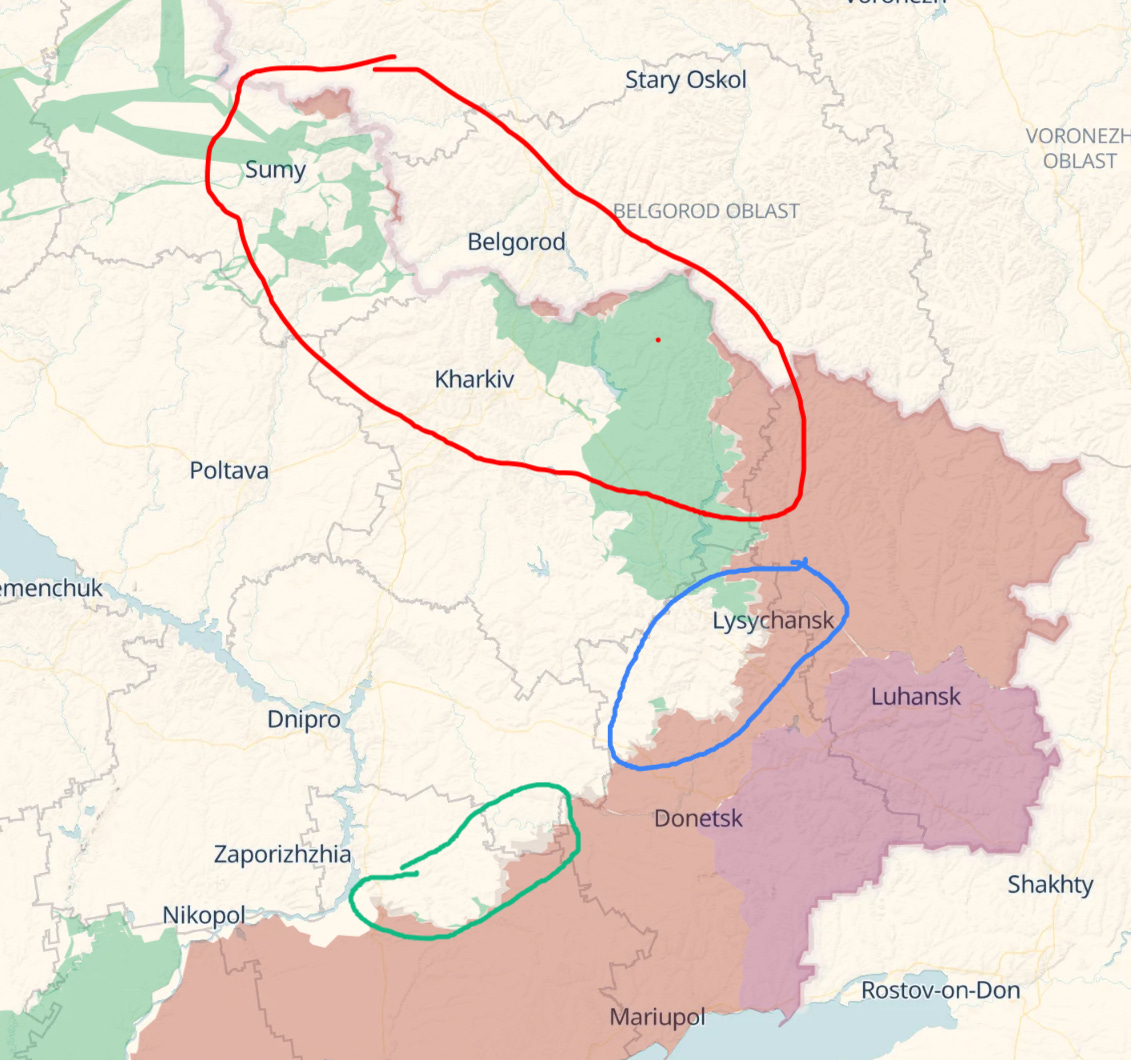
The frontline can essentially be split into three sectors of interest.
The first is the north (red circle), which includes the Sumy and Kharkov oblasts. Russian troops continue to press on the areas of these oblasts bordering with Russia, entering 1.5-2km in various parts of Sumy, and continuing fighting beyond the Ukrainian border city of Vovchansk. I would also include the city of Kupyansk in this northern sector, though it is located on the western part of the Kharkov oblast, facing the Lugansk oblast, not Russia proper. Russia and Ukraine continue to fight over this city after a Ukrainian counterattack in late 2025 took back large parts of it.
The north is the least prioritized section of the frontline by both sides, and the heavily fortified cities of Kharkiv and Sumy are not under any threat of falling (though they are regularly targeted by Russian air power).
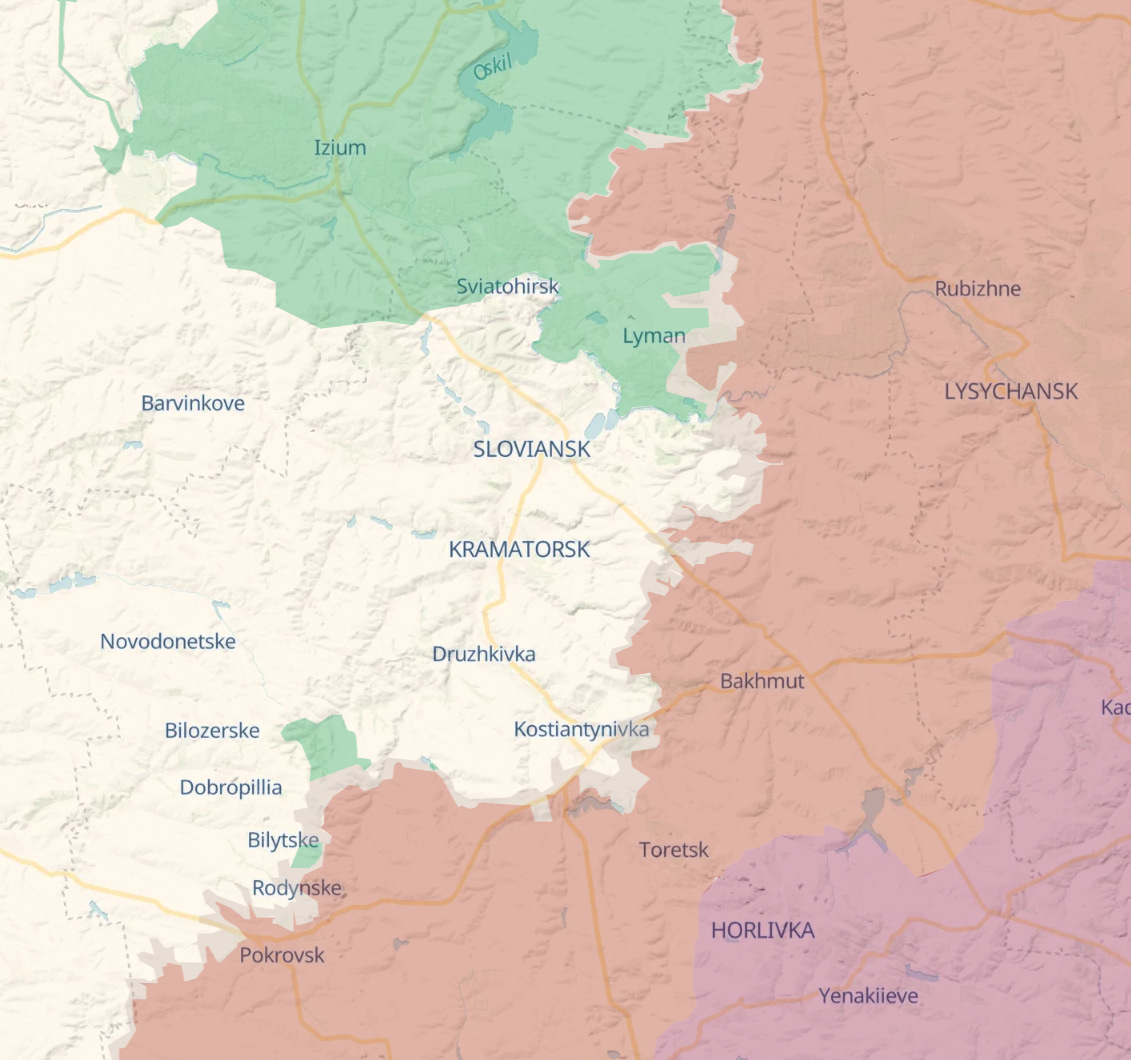
The second sector is the Donetsk oblast (blue sector). With Russia’s entire war in Ukraine theoretically motivated by the capture and protection of this area, it naturally has top priority. The main targets here are the last remaining major cities, the joint agglomeration of Sloviansk and Kramatorsk. The greatest Russian gains over the past month throughout all sectors of the frontline have been to the east of these two cities.
The Russians have been increasingly infiltrating the largely surrounded Donetsk town of Kostiantynivka, whose days are quite numbered. This town is located to the south of the Sloviansk/Kramatorsk agglomeration. Finally, the Russians have also been attempting (so far with little success) to move beyond Pokrovsk up to Dobropillia, a town in the southernmost part of the Donetsk oblast. In mid-2025, the Russian army achieved a surprise leap forward towards this town (~15km in a few days), an unheard-of event in this war since 2022. There were insufficient Russian forces to properly entrench their gains here, but the struggle continues.
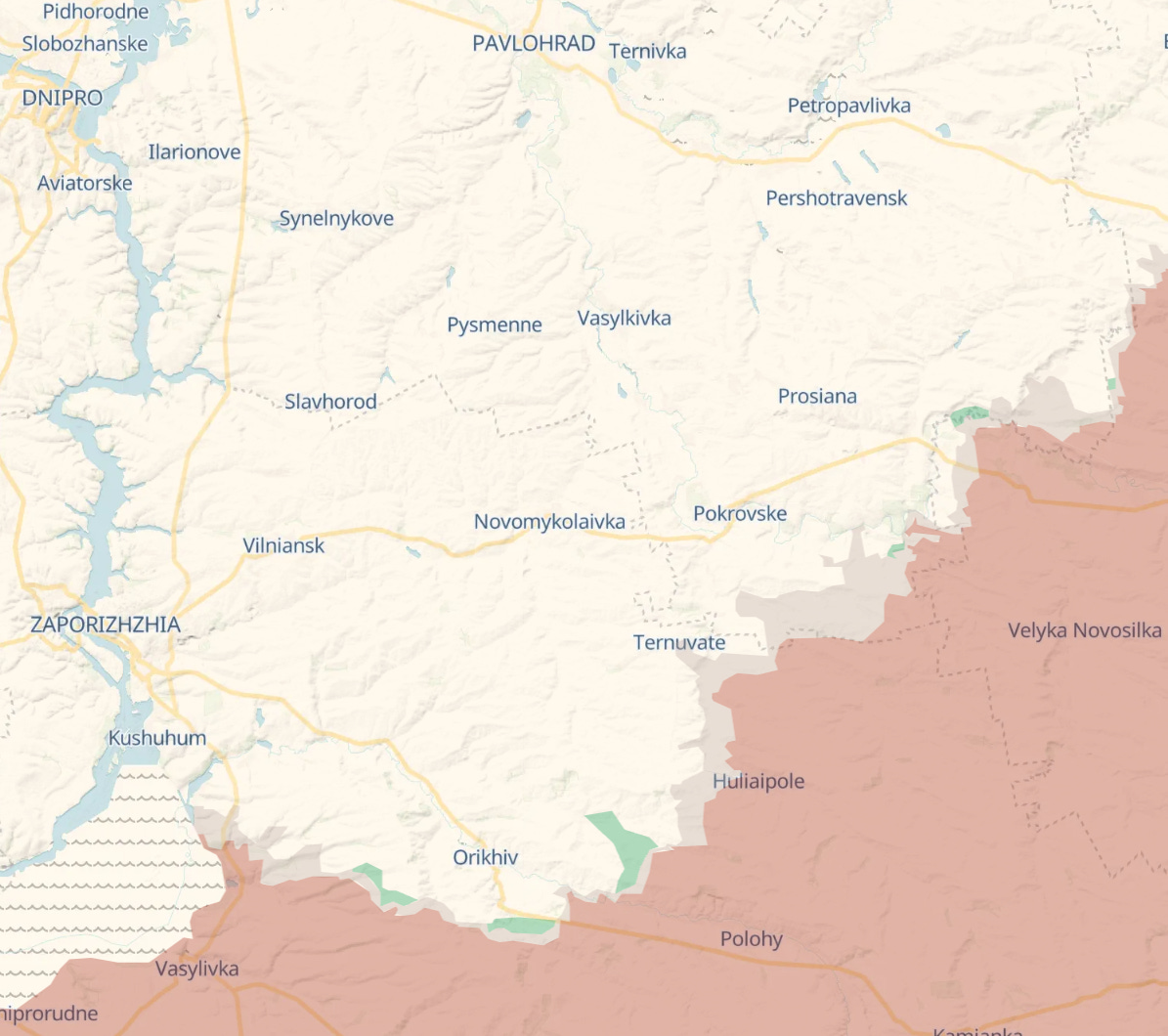
Finally, there is the third sector — the south (green circle). This largely refers to the Zaporizhzhia oblast, but also, further northeast, to the intersection of the Dnipropetrovsk oblast with Zaporizhzhia and Donetsk.
Unlike the Donetsk oblast, which has been fought over since 2014, the south has only seen combat since 2022. In the first days and weeks of the war, almost all of the Zaporizhzhia oblast was taken without a fight, leading to a number of questions regarding treason in the security services here. In any case, the big difference is that this area is much less fortified than the Donetsk or Kharkiv oblasts. The most effective Ukrainian units have generally been sent to fight in sectors further north.
This meant that 2025 saw the Russians advance massively in the south, with this sector responsible for the majority of gains that year. Weakly defended Ukrainian positions were infiltrated by small Russian assault groups.
However, in 2026, Ukrainian command took heed of the major risks posed by the Russian advances in the south to the cities of Zaporizhzhia and Dnipro, two of Ukraine’s largest and most economically important oblast capitals. As a result, commander-in-chief Oleksandr Syrsky sent assault force units here. These are troops he personally commands, unlike the majority of the army’s units, which are commanded by Corps generals. Correspondingly, critics say, they are happy to fulfill tasks which a responsible Corps general may be too merciful to give.
Syrsky gave these assault forces the mission of reversing Russian advances here, which they partially did using the same tactics as the Russians — rapid infantry advances behind enemy lines.
The result is a very chaotic picture in the south. Both the Russians and the Ukrainians are advancing, though Ukrainian advances have slowed down after a peak in February and early March. Though Zelensky and Syrsky spoke recently of upwards of 400 square kilometers retaken in the Donetsk/Zaporizhzhia/Dnepropetrovsk intersection, Ukrainian OSINT groups speak of under 100 square kilometers, and even there, it is very far from consolidated control.
Essentially, Ukrainian assault forces have taken quite significant losses merely in order to delay Russian offensive operations in the south by 1-2 months, as one Ukrainian military analyst wrote recently.
The most important event in the south is recent talk of a larger Russian offensive to take the city of Orikhiv. Without taking this fortified location, Russian advances towards the city of Zaporizhzhia face serious threats from their eastern flank.
How do the Russians prioritize these sectors? Over the course of January, February and March, a reduction of Russian assault operations was observed, in large part to excessively cold weather conditions. Writing on March 24, the Ukrainian OSINT project DeepState writes the ‘winter lull’ is over for both sides, with warmer weather allowing more attack operations.
Russian assault operations are now back to their usual level. In first place on March 24 is the Pokrovsk area, in the southern part of the Donetsk oblast. In second place is Kostyantinovka and the surrounding area, which is located further north in the Donetsk oblast, below Sloviansk/Kramatorsk. There were almost as many Russian assaults around Huliaipole, in the Zaporizhzhia oblast. In fourth place is the sector to the east of Sloviansk, around the villages of Fedorivka Druha-Novomarkove. Finally, in the northernmost section of the Donetsk oblast, activity around Lyman has also increased.
The south: overview
First of all, an overview of territorial control. Ukraine’s main OSINT project DeepState is far less euphoric than Zelensky and Syrsky.
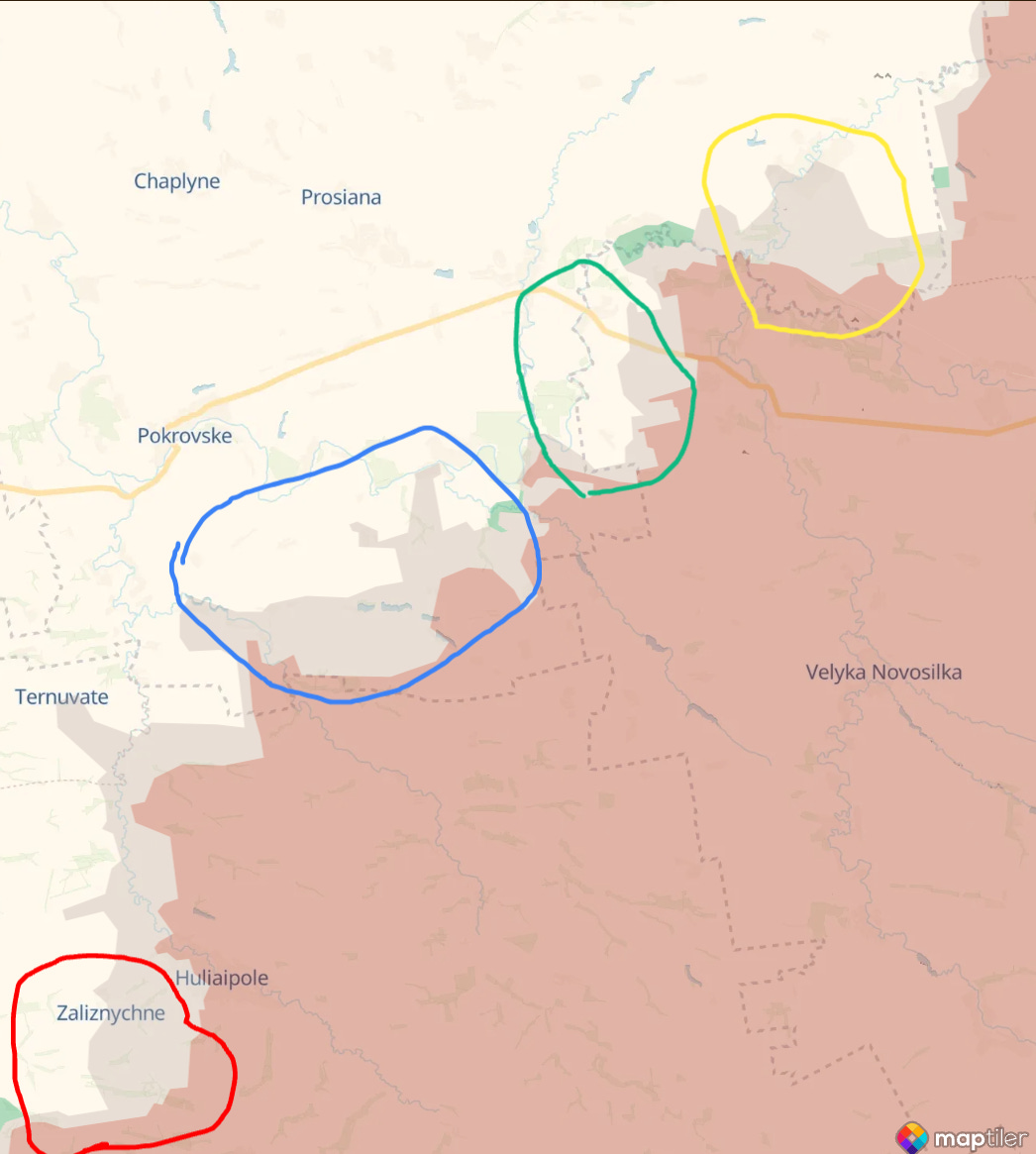
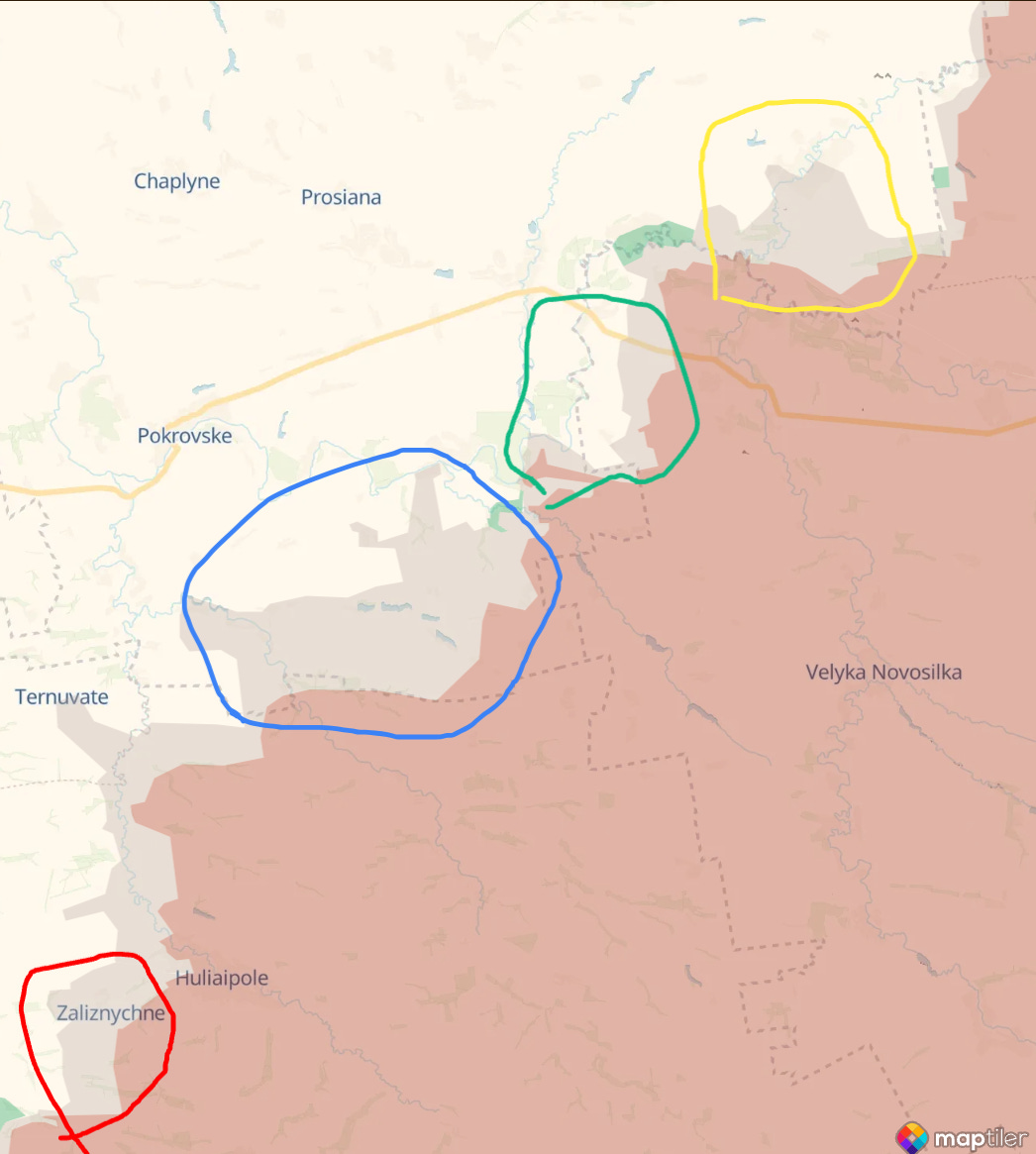
DeepState’s map doesn’t show any increase in Ukrainian control in the south. It merely shows the gray zone — areas where both Ukrainian and Russian forces are active, under constant pressure by enemy drones — eating into territory controlled by Russia. In a number of locations, it shows advances in territory consolidated by Russia (shaded red), but no advances in territory consolidated by Ukraine (shaded green). Circles are mine, and I will explain them below the maps.
March 1:
March 25:
Let’s break down this heterogeneous situation. In the south (red circle), the Zaporizhzhia oblast, below the town of Huliaipole and towards the town of Zaliznychne, Russian forces advanced. They advanced both in terms of consolidated territory (red) and contested territory (gray).
Directly north of Huliaipole, towards the town of Ternuvate, fighting continued. However, DeepState didn’t register any changes in territorial control. As we’ll see later, fierce fighting for Ternuvate continues, though this hasn’t resulted in much visible change.
Further north, we have the Dnepropetrovsk oblast — blue circle. DeepState depicts Ukrainian forces as increasing the contested area (gray) into previously consolidated Russian areas (red). But as everywhere else, DeepState does not claim that the Ukrainians have actually increased the territory consolidated by them (which would be colored green).
To the northwest, a part of the Dnepropetrovsk oblast (to the west) bordering with the Donetsk oblast (to the east). I drew a green circle here. Here, DeepState shows Russian advances, both in terms of consolidated territory (red) and contested territory (gray).
Finally, another part of the Dnipropetrovsk/Donetsk oblast intersection — yellow circle. Here, DeepState shows Russian advances in consolidated territory (red) to the east. The contested gray zone did not increase.
This means that DeepState does not show an increase in consolidated Ukrainian control in any of the south. It does, however, show an increased in consolidated Russian control in three out of four southern sectors. The only thing that is close to a Ukrainian advance was in two southern sectors, where Ukrainians contested territories previously (and still partially) held by Russia.
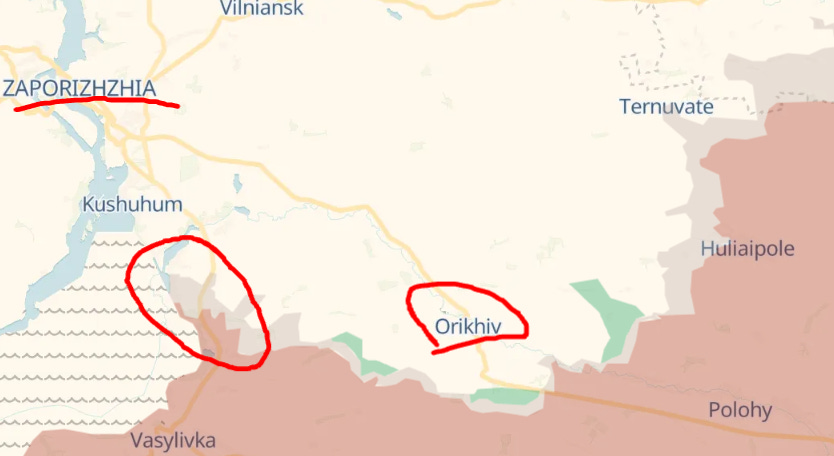
Let’s now talk about the southernmost part of the southern front, which did not enter the above maps. This is the part of the Zaporizhzhia oblast around the capital city of Zaporizhzhia itself (underlined), a city with a population upwards of 700,000 and a number of vital industrial assets.
The big rumor here is that Russia is gearing up for an offensive to take Orikhiv (red circle on the right). This is necessary in order to protect Russian troops advancing (red circle on the left) towards Zaporizhzhia along the eastern edge of the Kakhovka reservoir/Dnepr river.
I’ll now go into events in the south in more detail. We’ll examine three battle vectors — the Novoolekandrivka, Huliaipole, and Zaporizhzhia directions. The first two have seen the most action, but all three sectors are interrelated, with the key Russian goal to advance towards the oblast capital of Zaporizhzhia.
Novooleksandrivka direction
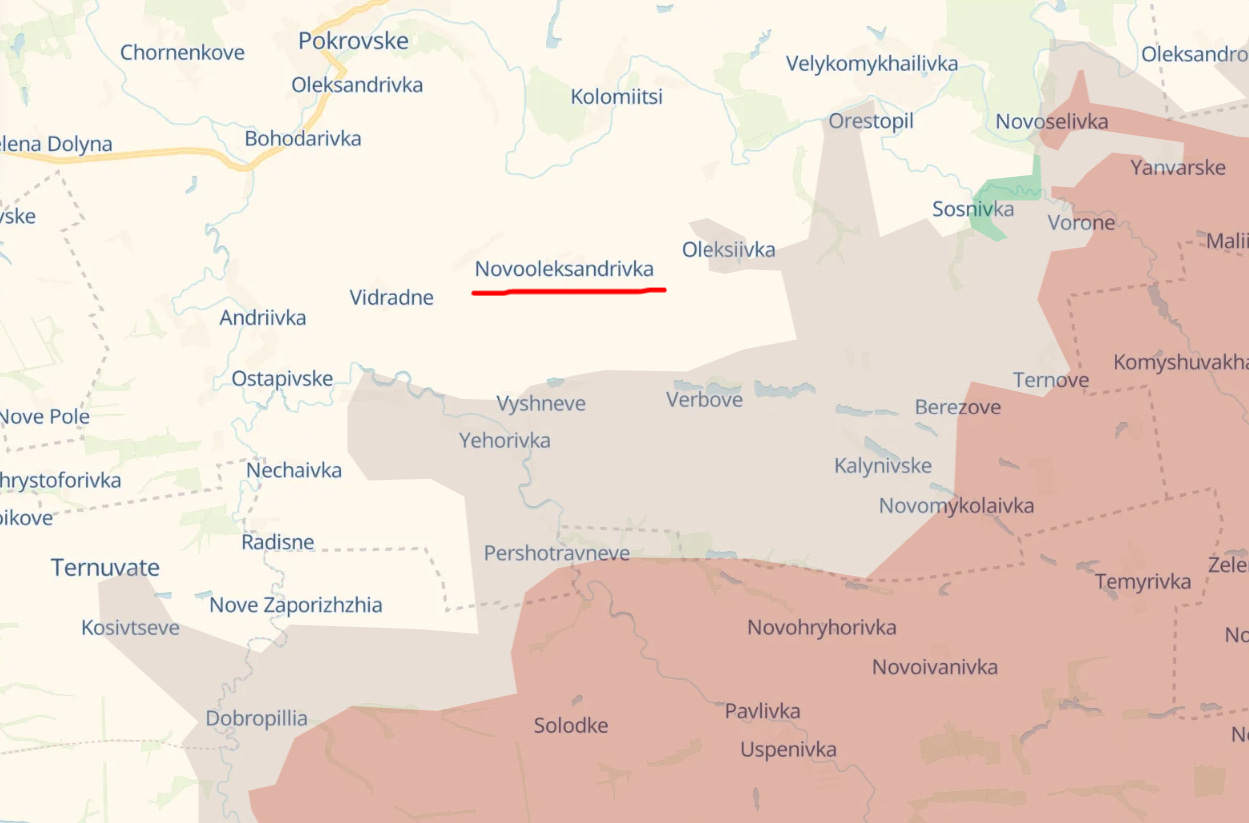
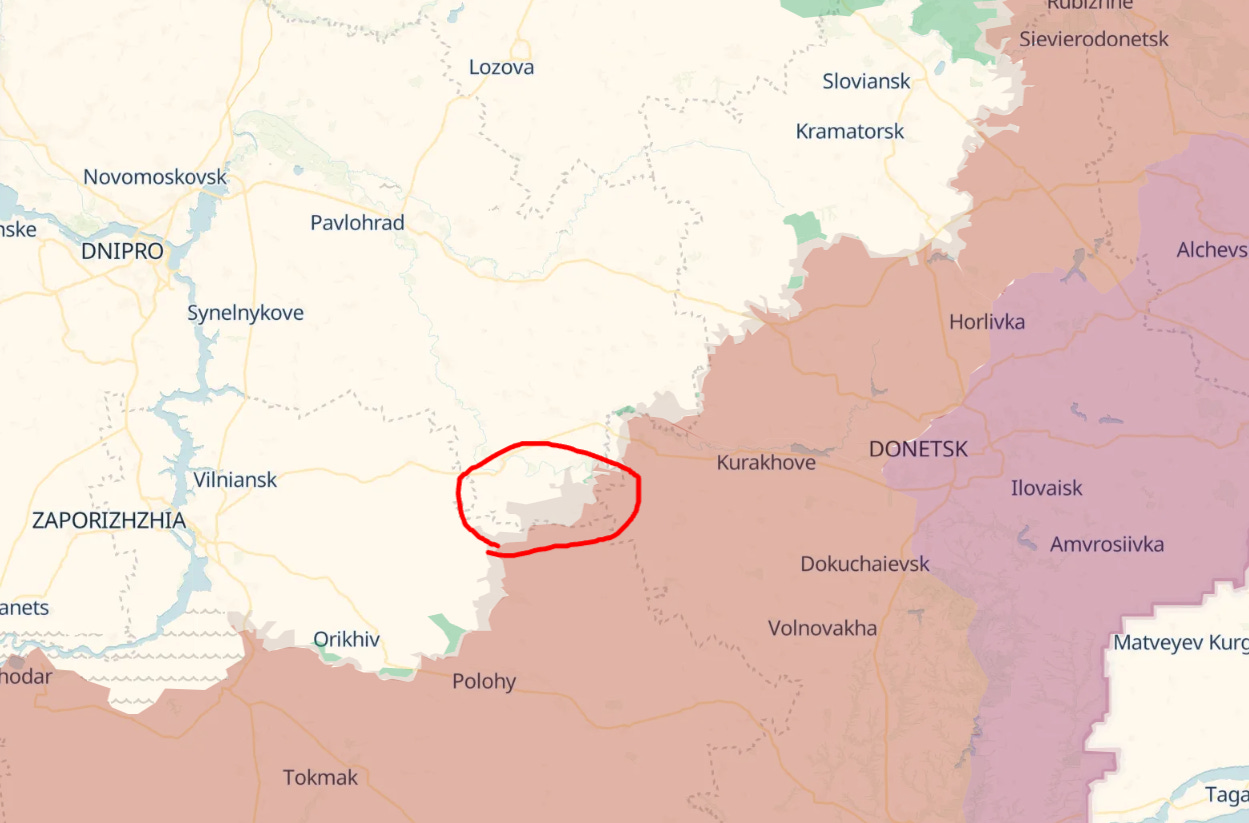
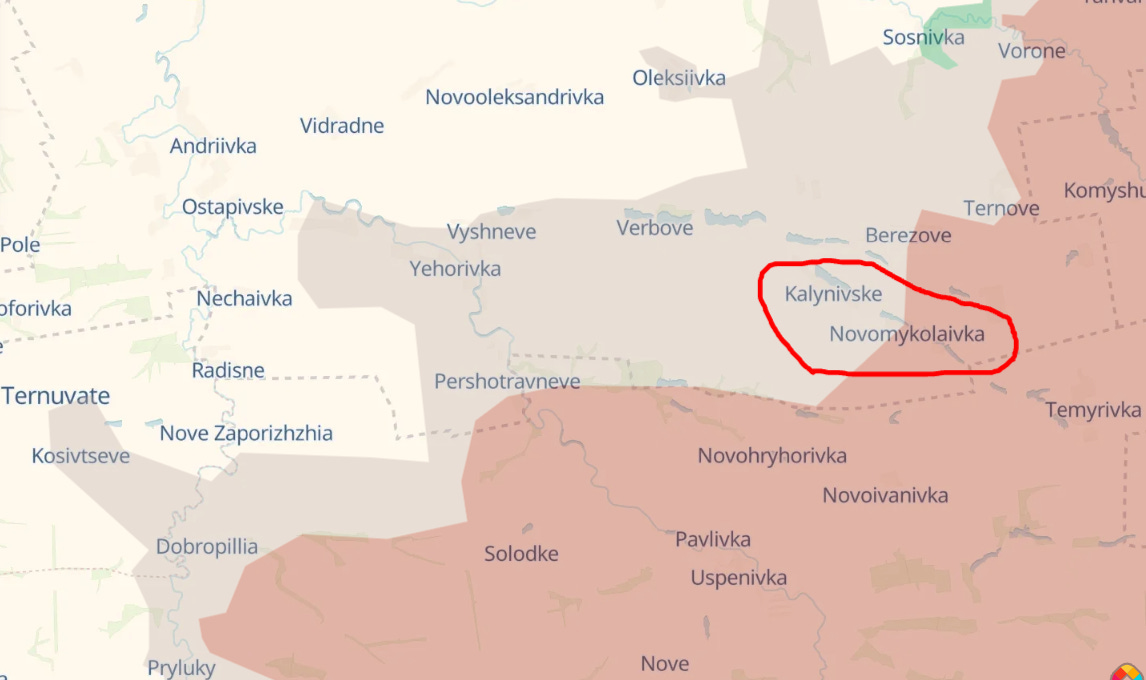
Let’s begin with the intersection of the Zaporizhzhia, Dnepropetrovsk and Donetsk oblasts, where some visible changes in territorial control have occurred, albeit chaotic and strategically insignificant. In Ukrainian terminology, this is often called the ‘Novooleksandrivka’ direction.
Closeup:
Zoomed out:
Note that the Donetsk oblast is on the eastern side of this intersection, the Dnepropetrovsk oblast on the northern side, and the Zaporizhzhia oblast on the southern side.
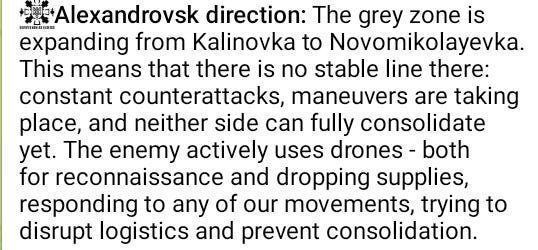
Like the rest of the south (and the entire war at this point), it is characterized by a vast chaotic gray zone. The Ukrainian serviceman Muchnoy Jugend described it quite aptly on March 20:
According to Ukrainian military analyst Kostyantin Mashovets on March 16, the Russians ‘shifted to active defense’ following Ukrainian counterattacks here in February/early March. For context, the Russian East Army Grouping is the operational grouping responsible for the Zaporizhzhia oblast. Under the command of East are units including the 36th, 5th, and 29th Combined Arms Armies (CAA).
Continue reading this post for free, courtesy of Events in Ukraine.